Category: Core Economics Concepts

  • Economic Growth Theories Explained: From Classical to Modern Perspectives – A Comprehensive Overview

    Economic Growth Theories Explained: From Classical to Modern Perspectives – A Comprehensive Overview

    Economic growth theories have evolved significantly over time, shaping our understanding of how economies develop and prosper. From the foundational ideas of classical economists to modern perspectives, these theories provide crucial insights into the mechanisms driving economic progress.

    The study of economic growth began with classical economists like Adam Smith and David Ricardo, who emphasized the importance of factors such as labor, capital, and technological progress. As economies have become more complex, theories have expanded to incorporate new elements. These range from demand-side factors to endogenous growth models, offering a richer understanding of the multifaceted nature of economic development.

    The landscape of economic growth theories continues to evolve, reflecting the changing dynamics of global economies. Modern perspectives now consider a broader range of factors, including the role of institutions, human capital, and innovation in driving sustained economic growth.

    Key Takeaways

    • Economic growth theories have progressed from classical models to more complex, multi-faceted approaches.
    • Various schools of thought, from classical to modern, offer unique insights into the drivers of economic development.
    • Understanding these theories is crucial for developing effective policies and strategies for sustainable economic growth.

    Historical Context of Economic Growth

    Economic growth has been shaped by major historical forces and transitions. Key developments like mercantilism, industrialization, and demographic shifts profoundly influenced economic thinking and growth trajectories across different eras.

    Pre-Classical and Mercantilism

    Mercantilism dominated economic thought from the 16th to 18th centuries. This doctrine emphasized accumulating gold and silver to increase national wealth. Governments sought to boost exports while limiting imports through tariffs and subsidies.

    Mercantilists viewed the economy as a zero-sum game. They believed one nation’s gain came at another’s expense. This perspective shaped colonial policies and trade relations.

    By the late 18th century, classical economists began challenging mercantilist ideas. Thinkers like Adam Smith argued for free markets and specialization to drive growth. This shift laid the groundwork for modern economic theories.

    The Industrial Revolution

    The Industrial Revolution marked a turning point in economic history. Beginning in Britain in the late 18th century, it spread across Europe and North America.

    Key developments included:

    • Mechanization of manufacturing
    • New energy sources like coal and steam
    • Improved transportation networks
    • Rise of factory systems

    These changes dramatically increased productivity and output. They also spurred urbanization and created new social classes. The Industrial Revolution highlighted the importance of technological progress in driving economic growth.

    Economists began focusing on capital accumulation and innovation as growth drivers. This period shaped classical and later neoclassical growth theories.

    The Demographic Transition

    The Demographic Transition describes population changes accompanying modernization. It typically involves three stages:

    1. High birth and death rates
    2. Declining death rates but high birth rates
    3. Low birth and death rates

    This transition profoundly impacted economic growth. Initially, population growth strained resources. Later, it provided labor for industrialization.

    Changing demographics influenced savings rates, consumption patterns, and human capital investment. These factors became central to modern growth theories.

    The Demographic Transition highlighted links between population dynamics and economic development. It remains relevant for understanding growth in developing economies today.

    Classical Economic Theories

    Classical economic theories laid the foundation for modern economic thought. These theories focused on long-term growth, capital accumulation, and the distribution of wealth in society.

    Adam Smith’s Wealth of Nations

    Adam Smith’s seminal work “The Wealth of Nations” introduced key concepts that shaped classical economic theory. He emphasized the importance of the division of labor in increasing productivity and economic growth.

    Smith argued that specialization and trade led to greater efficiency and wealth creation. He proposed the idea of an “invisible hand” guiding free markets towards optimal outcomes.

    The accumulation of capital played a crucial role in Smith’s theory. He believed that savings and investment were essential for economic progress and growth.

    David Ricardo’s Principles

    David Ricardo built upon Smith’s ideas and developed his own theories of economic growth and distribution. His work focused on the concept of comparative advantage in international trade.

    Ricardo introduced the theory of diminishing returns in agriculture. This theory suggested that as more labor and capital were applied to land, the marginal productivity would decrease.

    He also developed the idea of economic rent, which explained how landowners benefited from increasing agricultural prices. Ricardo’s theories influenced later classical economists and shaped discussions on income distribution.

    Malthusian Theory and Population Growth

    Thomas Malthus contributed to classical economics with his theory on population growth. He argued that population growth would outpace food production, leading to poverty and famine.

    Malthus believed that population grew exponentially while food production increased arithmetically. This mismatch would result in a “stationary state” where living standards could not improve.

    His theory had significant implications for economic growth and development. It influenced debates on poverty, welfare, and the limits of economic progress in classical economic thought.

    Keynesian Economics and Demand-Side Theories

    A bustling city street with buildings and shops, showcasing a mix of traditional and modern architecture, with people and cars moving about

    Keynesian economics revolutionized macroeconomic thought by emphasizing the role of aggregate demand in driving economic growth and employment. This approach challenged classical theories and introduced new policy tools to address economic stagnation.

    Keynesian Response to Economic Stagnation

    John Maynard Keynes developed his theories in response to the Great Depression of the 1930s. He argued that market economies could remain in a state of persistent unemployment without government intervention. Keynes proposed that during economic downturns, the government should increase spending and lower taxes to stimulate aggregate demand.

    This fiscal policy approach aimed to boost economic activity and create jobs. Keynesian theory suggested that increased government expenditure would have a multiplier effect, leading to higher income levels and further spending throughout the economy.

    The Concept of Effective Demand

    Effective demand is a central concept in Keynesian economics. It refers to the total amount of spending in an economy, including consumption, investment, and government expenditures. Keynes argued that effective demand determines the level of output and employment in an economy.

    According to this theory, insufficient effective demand can lead to economic stagnation and unemployment. Keynesian policies aim to increase effective demand through various measures:

    • Expansionary fiscal policy
    • Monetary stimulus
    • Encouraging private investment

    By focusing on the demand side of the economy, Keynesian theories provided a new framework for understanding economic fluctuations and growth.

    Neoclassical Economic Theories

    A library with classical and modern economic theory books on shelves, a globe, and a chart showing economic growth trends

    Neoclassical economic theories revolutionized our understanding of economic growth by introducing mathematical models and emphasizing the roles of capital, labor, and technology. These theories provided a framework for analyzing long-term economic expansion and productivity improvements.

    The Neoclassical Growth Model of Solow

    Robert Solow’s neoclassical growth model transformed economic analysis in the 1950s. It focused on the interaction between capital accumulation and technological progress as key drivers of economic growth.

    Solow’s model assumed diminishing returns to capital and labor when considered separately. However, it highlighted that technological advancements could offset these diminishing returns.

    The model introduced the concept of steady-state growth, where output, capital, and labor grow at the same rate. This equilibrium state is determined by savings rates, population growth, and technological progress.

    Solow’s work emphasized that long-term economic growth relies heavily on technological improvements rather than capital accumulation alone.

    Swan’s Contribution to Growth Theory

    Trevor Swan independently developed a similar growth model around the same time as Solow. His contributions complemented and expanded upon Solow’s work.

    Swan’s model also incorporated the idea of diminishing returns to capital and labor. It explored how changes in savings rates and population growth affect economic output.

    One of Swan’s key insights was the importance of the capital-output ratio in determining economic growth rates. He demonstrated that economies tend to converge towards a steady-state growth path.

    Swan’s work helped establish the foundations of modern growth theory and provided valuable tools for analyzing economic development.

    The Role of Technology and Productivity

    Neoclassical growth theory places significant emphasis on technological progress as the primary driver of long-term economic growth. This includes improvements in production processes, management techniques, and innovation.

    Technology is considered an exogenous factor in these models, meaning it is not explained within the model itself. It is assumed to grow at a constant rate over time.

    Productivity improvements resulting from technological advancements allow economies to produce more output with the same inputs. This leads to sustained economic growth even in the face of diminishing returns to capital and labor.

    The neoclassical approach highlights the importance of policies that promote research and development, education, and innovation to foster long-term economic growth.

    Endogenous Growth Theories
    A timeline of economic theories evolving from classical to modern perspectives, with arrows and connections illustrating the progression

    Endogenous growth theories emphasize internal factors that drive long-term economic growth. These models focus on the role of human capital, innovation, and knowledge in fostering sustained economic expansion.

    Innovation and the Importance of Human Capital

    Innovation plays a crucial role in endogenous growth models. These theories posit that investment in human capital, particularly through education and training, leads to increased productivity and technological advancements.

    Human capital accumulation is seen as a key driver of economic growth. As individuals acquire new skills and knowledge, they become more efficient and innovative in their work.

    The theory suggests that countries investing heavily in education and research and development (R&D) are likely to experience faster and more sustainable economic growth.

    Technological change is viewed as an endogenous process, driven by deliberate decisions of economic agents rather than external factors.

    Increasing Returns to Scale and Knowledge Spillovers

    Endogenous growth theories propose that economies can experience increasing returns to scale. This concept suggests that as the scale of production increases, the average cost per unit decreases.

    Knowledge spillovers play a significant role in this model. As firms and individuals innovate, their knowledge and ideas spread throughout the economy, benefiting others.

    These spillovers create positive externalities, leading to broader economic growth beyond the initial innovators.

    The theory argues that investments in knowledge-intensive industries can lead to self-sustaining growth cycles. This process can help explain persistent growth differences between countries.

    Policies promoting research, education, and innovation are seen as crucial for fostering long-term economic development in this framework.

    The Role of Government and Policy in Economic Growth

    A bustling city skyline with various government buildings and economic landmarks, surrounded by symbols of classical and modern economic theories

    Government policies and interventions significantly shape economic growth trajectories. Strategic investments and regulatory frameworks can foster or hinder economic development, influencing both short-term economic performance and long-term growth potential.

    Investment in Infrastructure and Education

    Government investment in infrastructure and education plays a crucial role in promoting economic growth.

    High-quality infrastructure, including transportation networks, telecommunications, and energy systems, facilitates efficient business operations and enhances productivity.

    Public spending on education contributes to human capital development, which is essential for innovation and technological progress. Countries with well-educated workforces tend to experience higher rates of economic growth.

    Governments can leverage public-private partnerships to fund large-scale infrastructure projects, spreading the financial burden and tapping into private sector expertise.

    Regulatory Frameworks and Economic Liberalism

    Regulatory frameworks significantly impact economic growth by shaping the business environment. Effective regulations protect property rights, enforce contracts, and maintain fair competition, fostering a conducive climate for investment and entrepreneurship.

    Economic liberalism advocates for minimal government intervention, emphasizing free markets and private enterprise as drivers of growth. This approach often involves deregulation and trade liberalization to promote competition and efficiency.

    Striking a balance between regulation and economic freedom is crucial. Overly burdensome regulations can stifle innovation and growth, while insufficient oversight may lead to market failures and economic instability.

    Modern Perspectives on Economic Development

    Contemporary economic theories explore the complex dynamics of growth and development in an increasingly interconnected world. These approaches consider factors like technological progress, human capital, and global trade relationships.

    Unified Growth Theory and Economic Convergence

    Unified Growth Theory attempts to explain the transition from stagnation to sustained economic growth. It considers how technological progress, population dynamics, and human capital accumulation interact over long periods.

    This theory suggests that as economies develop, they tend to converge in terms of per capita income levels. Economic development is viewed as a process where less developed countries catch up to more advanced ones.

    Factors driving convergence include:

    • Technology transfer
    • Foreign direct investment
    • Improvements in education and skills

    However, critics argue that convergence is not guaranteed and may depend on institutional quality and policy choices.

    Globalization and Its Economic Implications

    Globalization has profoundly impacted economic development worldwide. It involves the increasing interconnectedness of national economies through trade, capital flows, and information exchange.

    Key aspects of globalization include:

    • Expansion of international trade
    • Growth of multinational corporations
    • Increased labor mobility
    • Rapid spread of technology

    These factors have led to both opportunities and challenges for developing economies. Modern growth theory recognizes the importance of openness to trade and foreign investment in fostering economic development.

    However, globalization can also exacerbate inequality within and between countries. Policymakers must balance the benefits of integration with measures to protect vulnerable groups and industries.

    Challenges to Economic Growth

    Economic growth faces several key obstacles that can hinder progress and development. These challenges impact societies at multiple levels and require careful consideration to address effectively.

    Inequality and Income Distribution

    Income inequality poses a significant challenge to sustained economic growth. As wealth concentrates among a small percentage of the population, consumer spending power diminishes for many. This hampers overall economic expansion.

    Uneven income distribution can lead to social unrest and political instability. These factors deter investment and innovation, crucial drivers of growth. Progressive taxation and social programs aim to mitigate extreme inequality.

    Wealth concentration also limits economic mobility. Children from low-income families often lack access to quality education and opportunities. This perpetuates cycles of poverty across generations.

    Unemployment, Inflation, and Poverty

    High unemployment rates directly impact economic growth by reducing productivity and consumer spending. Prolonged joblessness can lead to skill erosion, making re-employment more difficult.

    Inflation erodes purchasing power and creates economic uncertainty. This can discourage long-term investments essential for growth. Central banks face the delicate task of managing inflation without stifling economic activity.

    Poverty traps millions in cycles of low productivity and limited opportunity. This reduces human capital development crucial for economic advancement.

    Policymakers must balance job creation, price stability, and poverty reduction to foster sustainable growth.

    Environmental Sustainability and Technological Disruption

    Environmental degradation threatens long-term economic stability. Climate change impacts agriculture, infrastructure, and human health. These effects can significantly impede growth.

    Resource depletion raises production costs and limits future economic potential. Sustainable practices are essential for maintaining growth trajectories.

    Rapid technological change disrupts traditional industries and job markets. While innovation drives growth, it also creates short-term economic dislocations. Creative destruction reshapes economies but can leave workers behind.

    Balancing innovation with environmental protection and workforce adaptation is crucial for sustainable economic growth.

    Future Directions in Economic Growth Research

    Economic growth research is evolving to address new challenges and opportunities in the global economy. Emerging technologies and shifting demographics are reshaping traditional economic paradigms.

    The Potential Impact of AI and Automation

    Artificial intelligence and automation are poised to revolutionize economic growth theories. These technologies may accelerate productivity gains beyond historical trends.

    Researchers are exploring how AI might enhance:

    • Innovation processes
    • Resource allocation efficiency
    • Labor market dynamics

    The integration of AI into economic models presents challenges for traditional growth theories. It necessitates new frameworks to account for rapid technological change and its effects on various economic sectors.

    Economists are also investigating potential disruptions to employment patterns. This includes analyzing skill requirements for future jobs and the need for adaptive education systems.

    Demographic Changes and Labor Market Trends

    Shifting population dynamics are reshaping labor markets globally. In developed countries, aging populations and youth bulges in developing nations create divergent economic challenges.

    Key areas of research include:

    Economists are developing models to predict how these demographic shifts will influence savings rates, investment patterns, and consumption behaviors.

    Labor market research is focusing on the gig economy and remote work trends. These developments are altering traditional employment structures and may require updates to economic growth theories.

    Studies are also examining the long-term effects of changing household compositions on economic growth. This includes the increasing prevalence of single-person households and dual-income families.


  • The Theory of Consumer Choice: How We Decide What to Buy – Analyzing Rational Decision-Making in Markets

    The Theory of Consumer Choice: How We Decide What to Buy – Analyzing Rational Decision-Making in Markets

    The Theory of Consumer Choice explores how individuals make decisions about what to purchase. It delves into the complex interplay of factors that influence our buying habits, from personal preferences to economic constraints. Understanding consumer choice is crucial for businesses, policymakers, and individuals alike, as it shapes market dynamics and economic outcomes.

    Consumer choice theory posits that people aim to maximize their satisfaction or utility within their budgetary limitations. This framework helps explain why consumers might opt for one product over another, or how they allocate their resources across various goods and services. It also sheds light on the concept of opportunity cost in decision-making processes.

    Recent research has expanded on traditional models to incorporate psychological factors and behavioral economics. These approaches recognize that consumers don’t always make purely rational choices, but are influenced by emotions, social pressures, and cognitive biases. By examining these elements, we gain a more nuanced understanding of consumer behavior in real-world scenarios.

    Key Takeaways

    • Consumer choice theory explains how individuals make purchasing decisions within their economic constraints
    • Psychological factors and behavioral economics play a significant role in consumer decision-making processes
    • Understanding consumer preferences is essential for businesses to develop effective marketing strategies and product offerings

    Fundamentals of Consumer Choice Theory

    Consumer choice theory examines how individuals make purchasing decisions based on their preferences, budget constraints, and the goal of maximizing utility. It provides a framework for understanding the economic behavior of consumers in the marketplace.

    Understanding Preferences and Utility

    Preferences form the foundation of consumer choice theory. They represent an individual’s likes and dislikes for different goods and services. Utility theory quantifies these preferences, assigning numerical values to satisfaction levels.

    Consumers typically prefer more of a good to less, assuming the good is desirable. This concept is known as non-satiation. Preferences are also assumed to be complete and transitive, meaning consumers can compare any two bundles of goods and their preferences are consistent.

    Utility functions represent these preferences mathematically. They assign higher numbers to more preferred bundles of goods. Common types include:

    • Cobb-Douglas utility functions
    • Perfect substitutes
    • Perfect complements

    Understanding utility helps economists model and predict consumer behavior in various market scenarios.

    The Concept of Budget Constraints

    Budget constraints limit the combinations of goods a consumer can purchase. They are determined by the consumer’s income and the prices of goods. The budget line represents all possible combinations of goods that can be bought with a given income.

    Mathematically, a budget constraint is expressed as:

    P1X1 + P2X2 = I
    

    Where:

    • P1 and P2 are prices of goods
    • X1 and X2 are quantities of goods
    • I is income

    Changes in income or prices shift the budget line. An increase in income moves it outward, while a decrease shifts it inward. Price changes rotate the budget line around its intercept.

    Utility Maximization Principle

    The utility maximization principle states that consumers choose the bundle of goods that provides the highest utility within their budget constraint. This occurs where the budget line is tangent to the highest attainable indifference curve.

    At this point, the marginal rate of substitution (MRS) equals the price ratio of the goods. The MRS represents the rate at which a consumer is willing to trade one good for another while maintaining the same utility level.

    Mathematically:

    MRS = P1 / P2
    

    This principle helps explain consumer behavior and demand patterns. It predicts that consumers will adjust their purchases in response to changes in prices or income to maximize their utility.

    Models of Consumer Behavior

    Consumer behavior models provide frameworks for understanding how individuals make purchasing decisions. These models incorporate key economic concepts to explain and predict consumer choices in the marketplace.

    Indifference Curve Analysis

    Indifference curve analysis is a fundamental model in consumer theory. It represents a consumer’s preferences between two goods. Each curve shows combinations of goods that give the consumer equal satisfaction.

    Points on higher curves indicate greater utility. The shape of these curves reflects the Marginal Rate of Substitution (MRS), which measures how much of one good a consumer will give up for another while maintaining the same level of satisfaction.

    Indifference curves are typically convex to the origin, indicating diminishing MRS. This shape reflects the principle that as consumers have more of one good, they’re willing to give up less of another to get more of it.

    The Role of Budget Constraints

    Budget constraints limit consumer choices based on income and prices. They’re represented by a line showing all possible combinations of goods a consumer can afford given their budget.

    The slope of the budget line is determined by the relative prices of the two goods. A steeper slope indicates that one good is relatively more expensive than the other.

    Where the budget line touches the highest indifference curve, we find the consumer’s optimal choice. This point maximizes utility given the budget constraint.

    Deriving the Demand Curve

    The demand curve shows the relationship between price and quantity demanded. It’s derived from indifference curves and budget constraints.

    As the price of a good changes, the budget line rotates. This rotation leads to new optimal consumption points. By plotting these points, we can construct the demand curve.

    The shape of the demand curve reflects both the substitution effect and income effect of price changes. Generally, as price decreases, quantity demanded increases, resulting in a downward-sloping curve.

    Factors like income, preferences, and prices of related goods can shift the entire demand curve. These shifts are distinct from movements along the curve caused by price changes of the good itself.

    Consumer Choices and Market Demand

    A bustling marketplace with various products displayed on shelves and tables, with consumers browsing and making purchasing decisions

    Consumer choices drive market demand, shaping the goods and services available. Income levels and substitution effects play crucial roles in determining purchasing decisions and overall market trends.

    From Individual to Market Demand

    Individual consumer choices aggregate to form market demand. Consumers select bundles of goods based on preferences and budget constraints. These decisions involve trade-offs between different products.

    Economic mental illusions can influence how consumers view their options. Preferences for specific goods or services may shift based on how choices are presented.

    Market demand emerges as the sum of individual consumer demands. This aggregate demand determines which products succeed or fail in the marketplace.

    Companies analyze consumer behavior to predict market trends. They adjust their offerings to meet changing preferences and maximize sales.

    Impact of Income and Substitution Effects

    Income effects occur when changes in purchasing power alter consumer choices. As income rises, demand for normal goods typically increases. Conversely, demand for inferior goods may decrease.

    Substitution effects happen when price changes make alternatives more attractive. Consumers may switch to similar but less expensive options when faced with price increases.

    These effects combine to shape overall market demand. Cross-price elasticities between products reveal how substitutable goods are in consumers’ minds.

    Income and substitution effects can lead to significant shifts in demand patterns. Industries must adapt to these changes to remain competitive and meet consumer needs.

    Psychological Factors Influencing Consumer Choice

    A person standing in front of a shelf of products, contemplating options with a thoughtful expression. Surrounding them are various factors influencing their decision, such as price tags, product features, and brand logos

    Consumer choices are heavily influenced by psychological factors that shape decision-making processes. These factors include cognitive biases, mental shortcuts, and the way individuals mentally categorize financial decisions.

    Behavioral Economics and Consumer Decisions

    Behavioral economics examines how psychological factors impact economic decisions. This field challenges traditional economic models by recognizing that consumers often make irrational choices.

    Studies show that framing effects significantly influence purchase decisions. For example, consumers tend to prefer a product advertised as “90% fat-free” over one labeled “10% fat,” despite being nutritionally identical.

    Consumer psychology research has shown that emotional states play a crucial role in purchasing behavior. Consumers in positive moods are more likely to make impulsive purchases.

    Social proof also affects consumer choices. People often rely on the opinions and actions of others when making decisions, leading to trends and popular product adoptions.

    Heuristics and Biases in Choices

    Heuristics are mental shortcuts that help consumers make quick decisions. While efficient, these shortcuts can lead to biases and suboptimal choices.

    The availability heuristic causes consumers to overestimate the likelihood of events they can easily recall. This bias often influences product choices based on memorable advertising or recent news.

    Anchoring bias affects price perceptions. Initial price points serve as “anchors” that influence consumers’ willingness to pay, even when those anchors are arbitrary.

    The endowment effect makes consumers value items they own more highly than identical items they do not own. This bias impacts selling and trading behaviors in consumer markets.

    Mental Accounting and Spending Behavior

    Mental accounting refers to the way consumers categorize and evaluate financial activities. This cognitive process significantly influences spending and saving decisions.

    Consumers often create separate mental accounts for different types of expenses. For example, they might allocate specific budgets for groceries, entertainment, and savings.

    The pain of paying varies across payment methods. Cash payments typically feel more psychologically painful than credit card purchases, leading to different spending patterns.

    Loss aversion in mental accounting causes consumers to be more sensitive to perceived losses than equivalent gains. This principle affects how consumers view discounts versus surcharges.

    Time discounting influences long-term financial decisions. Consumers often prioritize immediate rewards over future benefits, impacting choices in areas like retirement savings and insurance.

    Types of Goods and Consumer Preferences

    A colorful display of various goods, including food, clothing, electronics, and more. A consumer is making a decision among the options available

    Consumers encounter various categories of goods in the marketplace, each influencing their purchasing decisions differently. Understanding these distinctions and how preferences shape choices is crucial for analyzing consumer behavior.

    Understanding Different Goods Categories

    Economists classify goods into several types based on their characteristics and how consumers interact with them. Normal goods are those for which demand increases as income rises. Examples include luxury cars and designer clothing. Inferior goods, conversely, see decreased demand as income grows, such as generic brands or public transportation.

    Necessities and luxuries form another important distinction. Necessities have inelastic demand, meaning consumption doesn’t change much with price fluctuations. Food and housing fall into this category. Luxuries, like vacations or jewelry, have elastic demand and are more sensitive to price changes.

    Complementary goods are used together, such as printers and ink cartridges. Substitute goods can replace each other, like butter and margarine. These relationships significantly impact consumer choices and market dynamics.

    Consumer Preferences for Goods

    The economic theory of choice centers around consumer preferences. These represent the relative desirability of different goods and services.

    Preferences are often assumed to follow certain principles, such as completeness and transitivity. Completeness means consumers can compare any two bundles. Meanwhile, transitivity means that if A is preferred to B, and B to C, then A is preferred to C.

    The concept of non-satiation is crucial in understanding preferences. It suggests that consumers always prefer more of a good to less, assuming all else remains equal. This principle underpins many economic models of consumer behavior.

    Consumption values also play a significant role in shaping preferences. These include functional value, social value, and emotional value.

    Functional value is the utility derived from performance, while social value is the association with specific groups. Emotional value, on the other hand, refers to the feelings or affective states a product generates.

    Consumer spending patterns reflect these preferences. Factors like price, quality, brand loyalty, and personal taste all influence how individuals allocate their resources among different types of goods.

    Applied Consumer Choice Theory

    A person comparing prices and features of different products in a store

    Consumer choice theory has significant real-world applications, particularly in retail settings. It helps explain how individuals make purchasing decisions based on their preferences and budget constraints. Utility functions play a crucial role in modeling these choices mathematically.

    Real-World Applications in Retail

    Consumer behavior in retail environments is heavily influenced by choice theory principles. Grocery stores, for example, strategically arrange products to maximize sales based on consumer preferences.

    Product placement and pricing strategies also reflect an understanding of ordinal utility. This is where consumers rank options rather than assigning specific numerical values.

    Retailers use data analytics to predict purchasing patterns and optimize inventory. This application of choice theory helps stores stock items that align with consumer demand.

    Marketing campaigns are designed to influence consumer preferences and perceived utility of products. By highlighting certain attributes, retailers can shape consumer choices.

    Utility Function in Consumer Decisions

    The utility function is a mathematical representation of consumer satisfaction. It helps explain how individuals allocate their limited resources among various goods and services.

    Diminishing marginal utility is a key concept in applied consumer choice theory. As consumers acquire more of a particular good, the additional satisfaction from each unit typically decreases.

    Economists use utility functions to model consumer choices in various scenarios. These models help predict how changes in prices or income might affect purchasing decisions.

    Businesses can use utility function analysis to design product bundles or pricing strategies that maximize consumer satisfaction and company profits.

    Economists’ Perspective on Consumer Choice

    Economists have developed sophisticated models to explain and predict consumer behavior. These models focus on rational decision-making processes and the impact of various factors on purchasing choices.

    Historical Context and Evolution

    The study of consumer choice in economics dates back to the late 19th century. Early economists like Alfred Marshall introduced concepts such as marginal utility and demand curves.

    In the 1930s, John Hicks and R.G.D. Allen developed indifference curve analysis, providing a more robust framework for understanding consumer preferences.

    The 1950s saw the emergence of revealed preference theory, which inferred consumer preferences from observed choices rather than assuming them.

    More recent developments include behavioral economics, which incorporates psychological insights into economic models of consumer behavior.

    Key Contributions of Notable Economists

    Paul Samuelson made significant advances in consumer theory with his work on revealed preferences. He demonstrated how consumer behavior could be analyzed without relying on unobservable utility functions.

    Gary Becker expanded the scope of consumer choice theory by applying economic analysis to social issues. His work showed how economic principles could explain various aspects of human behavior, including family decisions and addiction.

    Daniel Kahneman and Amos Tversky’s prospect theory challenged traditional assumptions about rational decision-making. Their research highlighted how cognitive biases influence consumer choices, leading to the development of behavioral economics.

    Richard Thaler’s work on mental accounting and nudge theory further expanded our understanding of how consumers make economic decisions in real-world situations.

  • Keynesian Economics vs. Classical Economics: A Comparison – Key Differences Explained

    Keynesian Economics vs. Classical Economics: A Comparison – Key Differences Explained

    Keynesian economics and classical economics represent two influential schools of thought in modern economic theory. These approaches offer contrasting perspectives on how economies function and the role of government intervention.

    Keynesian economics emphasizes active government involvement to manage aggregate demand, while classical economics advocates for free markets with minimal government interference.

    The debate between Keynesian and classical economics has shaped economic policy discussions for decades. Keynesian theory gained prominence in the aftermath of the Great Depression, challenging the prevailing classical view.

    Classical economists argue that markets are self-regulating and efficient, whereas Keynesians contend that market failures can lead to economic instability, necessitating government intervention.

    Understanding the differences between these economic frameworks is crucial for policymakers, investors, and citizens alike. The ongoing discourse between Keynesian and classical economics continues to influence contemporary economic policies and academic debates, shaping our understanding of economic phenomena and potential solutions to economic challenges.

    Key Takeaways

    • Keynesian economics advocates for active government intervention, while classical economics favors free-market mechanisms.
    • The two schools differ in their approaches to equilibrium, output, and the role of monetary policy.
    • Both theories continue to influence modern economic policies and academic discussions on macroeconomic phenomena.

    Historical Context and Philosophical Foundations

    Classical economics and Keynesian economics emerged in distinct historical periods, shaping their core principles and approaches. These schools of thought developed in response to specific economic challenges and philosophical foundations of their times.

    The Emergence of Classical Economics

    Classical economics arose in the late 18th and early 19th centuries. Adam Smith’s “The Wealth of Nations” laid the groundwork for this school of thought in 1776.

    Classical economists advocated for laissez-faire policies and minimal government intervention. They believed in the “invisible hand” of the market to regulate economic activity.

    Key figures like David Ricardo and John Stuart Mill further developed classical economic theory. They focused on long-term economic growth and the distribution of wealth among social classes.

    Classical economics emphasized supply-side factors and the role of savings in driving investment. This school of thought dominated economic thinking until the early 20th century.

    Keynesian Economics and the Great Depression

    The Great Depression of the 1930s challenged classical economic theories. John Maynard Keynes introduced a new approach to address widespread unemployment and economic stagnation.

    Keynes argued that government intervention was necessary to stabilize the economy. His 1936 book “The General Theory of Employment, Interest, and Money” revolutionized economic thinking.

    Keynesian economics focused on demand-side factors and short-term economic fluctuations. It proposed that government spending could stimulate economic growth during recessions.

    This new school of thought gained prominence as governments sought solutions to the economic crisis. Keynesian policies influenced economic decision-making in many countries throughout the mid-20th century.

    Fundamental Principles

    Classical and Keynesian economics offer contrasting views on how economies function and the role of government. These schools of thought differ in their approaches to market equilibrium, government intervention, and economic growth.

    The Classical Theory of Economics

    Classical economics emphasizes the free market and minimal government intervention. It posits that economies naturally tend towards equilibrium through the “invisible hand” of market forces.

    Competition is seen as a key driver of efficiency and growth. Classical economists believe that supply creates its own demand, a concept known as Say’s Law.

    The theory suggests that prices and wages are flexible, allowing markets to clear quickly. In this view, unemployment is considered voluntary and temporary.

    Classical economists argue that government intervention can distort market signals and hinder economic progress. They advocate for free trade and limited regulation to promote capital accumulation and economic growth.

    Keynesian Economics Overview

    Keynesian economics, developed by John Maynard Keynes, offers a different perspective on economic functioning. It emphasizes the importance of aggregate demand in driving economic activity.

    Keynesians argue that economies can experience prolonged periods of disequilibrium, particularly during recessions. They believe that prices and wages can be “sticky,” leading to market inefficiencies.

    This school of thought supports active government intervention to stabilize the economy. Fiscal and monetary policies are seen as essential tools to manage economic fluctuations.

    Keynesians challenge the notion of a self-correcting market. They argue that government spending can stimulate economic growth, especially during downturns when private sector activity is weak.

    Approach to Equilibrium and Output

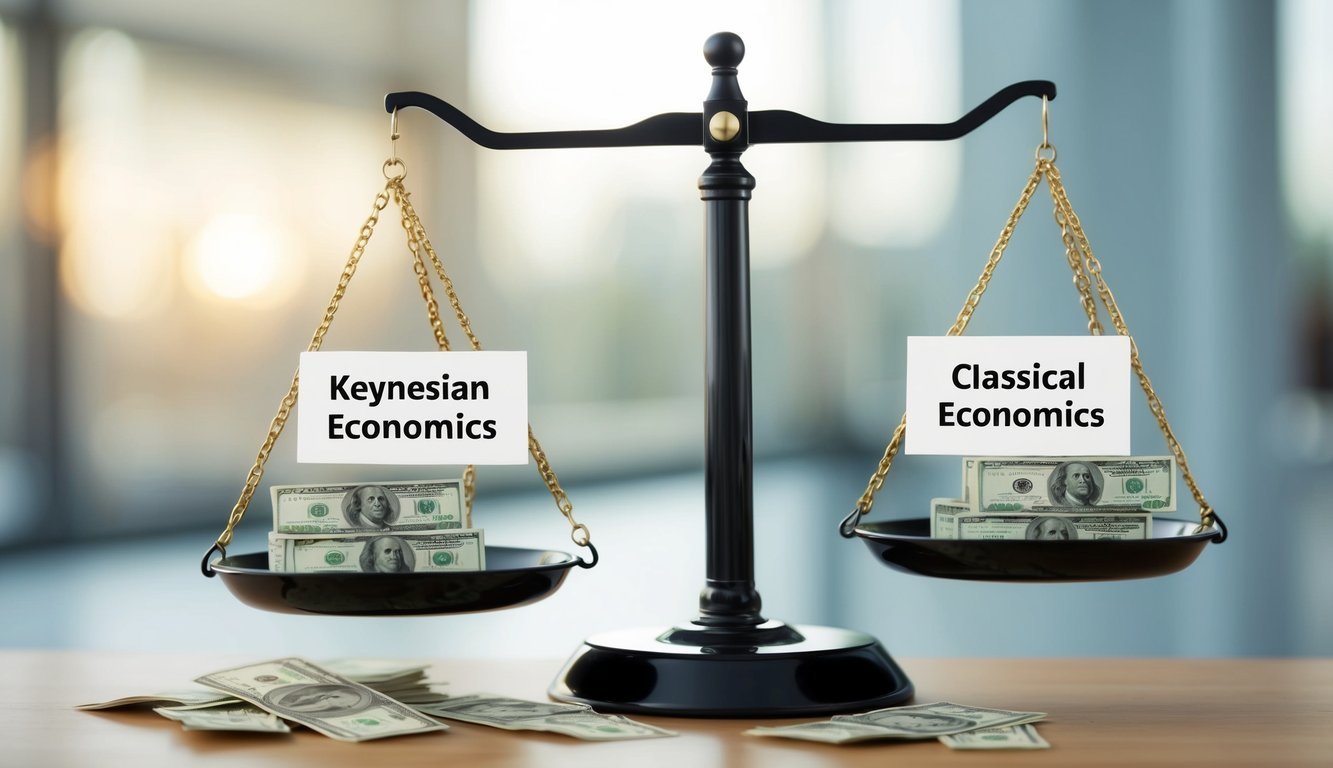
    A scale tipping between two sides, one labeled "Keynesian Economics" and the other "Classical Economics," with various economic indicators on each side

    Keynesian and Classical economics differ significantly in their views on economic equilibrium and output determination. These contrasting approaches shape their policy recommendations and understanding of market dynamics.

    Role of Demand in Keynesian vs. Classical Views

    Keynesian economics emphasizes the crucial role of aggregate demand in determining economic output. This school of thought argues that demand drives production and employment levels. In the Keynesian model, changes in demand can lead to significant fluctuations in output and employment.

    The multiplier effect is a key concept in Keynesian theory. It suggests that an initial increase in spending can result in a larger overall increase in economic output and income.

    Classical economists, in contrast, believe that the economy naturally tends towards full employment equilibrium. They argue that prices and wages are flexible, allowing markets to clear and reach equilibrium without government intervention.

    Supply and Output in Classical Economics

    Classical economics focuses on the supply side of the economy. This school of thought maintains that economic output is primarily determined by factors of production such as labor, capital, and technology.

    The classical view posits that supply creates its own demand, a concept known as Say’s Law. This principle suggests that the production of goods and services generates income, which in turn creates demand for those goods and services.

    Classical economists argue that long-term economic growth is driven by increases in productivity and improvements in technology. They believe that government intervention is unnecessary and can potentially hinder economic efficiency.

    Government’s Role in the Economy

    A bustling marketplace with government officials overseeing production and trade, contrasting with a serene countryside scene where markets operate freely

    Keynesian and Classical economics present contrasting views on government involvement in economic affairs. These perspectives shape fiscal policies and public spending approaches.

    Government Spending and Fiscal Policy

    Keynesian economics advocates for active government intervention during economic downturns. This approach emphasizes the use of fiscal policy to stimulate demand and boost economic growth.

    Keynesians argue that increased government spending can help offset declines in private sector activity. They support deficit spending during recessions to jumpstart the economy.

    Government borrowing is seen as a tool to finance expansionary fiscal policies. Keynesians believe this can create a multiplier effect, where initial spending leads to broader economic benefits.

    Proponents of this view often prioritize full employment over a strictly balanced budget. They argue that focusing solely on deficit reduction during downturns can worsen economic conditions.

    Classical Economics and Limited Intervention

    Classical economics advocates for minimal government involvement in the economy. This school of thought emphasizes the power of free markets to self-regulate and achieve optimal outcomes.

    Proponents argue that government intervention can distort market signals and lead to inefficiencies. They favor limited fiscal policy and promote balanced budgets as a means to maintain economic stability.

    Classical economists believe in the concept of “crowding out,” where increased government spending can reduce private investment. They argue this can hinder long-term economic growth.

    This perspective favors supply-side policies, such as tax cuts and deregulation, to stimulate economic activity. The focus is on creating conditions for businesses to thrive rather than direct government stimulus.

    Monetary Policy and Interest Rates

    A scale with a stack of money on one side and a seesaw with interest rate symbols on the other

    Monetary policy and interest rates play crucial roles in both Keynesian and Classical economic theories. These approaches differ significantly in their views on how these factors influence economic outcomes and the appropriate policy responses.

    Interest Rate Influence According to Keynes

    Keynesian economics emphasizes the importance of interest rates in shaping economic activity. Keynes argued that lower interest rates stimulate investment and consumption, boosting aggregate demand.

    In the Keynesian view, monetary policy can be an effective tool for managing the economy. Central banks can influence interest rates to encourage borrowing and spending during economic downturns.

    Keynesians believe that changes in the money supply affect real economic variables. They argue that monetary policy can have a significant impact on output and employment in the short run.

    Classical Theory on Monetary Policy

    Classical economists hold a different perspective on monetary policy and interest rates. They believe in the concept of money neutrality, where changes in the money supply only affect nominal variables like prices and wages.

    According to classical theory, interest rates are determined by real factors such as savings and investment. Monetary policy has limited long-term effects on the real economy.

    Classical economists argue that the economy tends towards full employment equilibrium naturally. They view monetary policy as primarily influencing the price level rather than real output or employment.

    In this framework, expansionary monetary policies may lead to inflation without sustainable increases in economic growth or employment levels.

    Effects on Economic Stability and Growth

    A bustling city with contrasting elements - one side depicts government intervention and public spending, while the other side showcases free market principles and minimal government involvement

    Keynesian and classical economics offer contrasting perspectives on economic stability and growth. Their approaches to managing fluctuations and fostering long-term prosperity differ significantly, shaping policy decisions and market outcomes.

    Economic Fluctuations and Stabilization Policies

    Keynesian economics advocates for active government intervention to address economic fluctuations. This school of thought believes that during downturns, the government should implement expansionary policies to stimulate aggregate demand.

    Such policies may include:

    • Increased government spending
    • Lower interest rates
    • Tax cuts

    Keynesians argue these measures can help stabilize the economy and reduce unemployment during recessions.

    Classical economists, conversely, favor minimal government intervention. They believe that markets are self-correcting and that prices, wages, and interest rates will adjust naturally to restore equilibrium.

    This approach suggests that short-term fluctuations are a normal part of the economic cycle and do not require extensive government action.

    Long-term Growth and Market Self-correction

    Classical economics emphasizes the importance of long-term equilibrium and market forces in driving economic growth. This perspective holds that free markets, unencumbered by excessive regulation, will lead to optimal resource allocation and sustained growth.

    Key elements of the classical view include:

    • Focus on supply-side factors
    • Emphasis on savings and investment
    • Belief in price flexibility

    Keynesians, while not dismissing long-term growth, place greater emphasis on short-term stability. They argue that without proper management of economic fluctuations, long-term growth potential may be compromised.

    Both schools acknowledge the importance of productivity and technological progress in driving economic expansion, but differ in their approaches to achieving these goals.

    Responses to Economic Crisis

    Keynesian and classical economists propose contrasting approaches to addressing economic crises. Their differing policy recommendations reflect fundamental disagreements about the causes of downturns and the appropriate role of government intervention.

    Keynesianism in Recessions and Depressions

    Keynesian economists advocate for active government intervention during economic crises. They view recessions as primarily demand-driven, caused by a lack of aggregate spending in the economy.

    To combat unemployment and stimulate growth, Keynesians recommend:

    • Expansionary fiscal policy (increased government spending and tax cuts)
    • Monetary stimulus through lower interest rates
    • Direct job creation programs

    These measures aim to boost aggregate demand, encouraging businesses to hire and invest. Keynesians argue this approach can shorten recessions and mitigate their severity.

    Critics contend that Keynesian policies may lead to increased government debt and potential inflationary pressures in the long term.

    Classical Response to Economic Downturns

    Classical economists favor a more hands-off approach to economic crises. They emphasize supply-side factors and believe markets will naturally correct themselves without extensive government intervention.

    Key classical policy recommendations include:

    • Reducing regulations to promote business flexibility
    • Lowering taxes to incentivize work and investment
    • Maintaining price stability through controlled monetary policy

    Classical economists argue these measures allow the economy to adjust more quickly to changing conditions. They contend that government intervention can prolong downturns by distorting market signals and misallocating resources.

    Critics of this approach argue it may lead to prolonged periods of high unemployment and economic hardship during severe recessions.

    Inflation and Unemployment

    The relationship between inflation and unemployment is a key area of divergence between Keynesian and Classical economic theories. Their contrasting approaches to managing these macroeconomic variables have significant implications for policy decisions.

    Fighting Inflation: A Keynesian Approach

    Keynesian economics posits a trade-off between inflation and unemployment, known as the Phillips Curve. This theory suggests that lower unemployment rates are associated with higher inflation, and vice versa.

    Keynesians argue that some inflation can be beneficial for economic growth. They believe governments should use fiscal and monetary policies to manage aggregate demand and achieve a balance between inflation and unemployment.

    During economic downturns, Keynesians advocate for expansionary policies to boost employment, even if it leads to moderate inflation. They view unemployment as a more pressing concern than price stability in such situations.

    Classical Economics and the Natural Rate of Unemployment

    Classical economists reject the long-term trade-off between inflation and unemployment proposed by Keynesians. They argue that the economy tends towards a natural rate of unemployment in the long run, regardless of the inflation rate.

    This school of thought emphasizes price stability as a primary goal. Classical economists believe that attempts to lower unemployment below its natural rate through expansionary policies will only result in higher inflation without sustained job creation.

    They advocate for minimal government intervention, arguing that free markets will naturally adjust to reach equilibrium. Classical theory suggests that unemployment is primarily caused by structural factors rather than insufficient aggregate demand.

    Classical economists focus on supply-side policies to address unemployment, such as improving labor market flexibility and enhancing workforce skills. They prioritize long-term price stability over short-term employment gains.

    Contemporary Application and Debates

    The ongoing dialogue between Keynesian and Classical economic theories continues to shape modern economic policies and discussions. Their influences are evident in current fiscal and monetary approaches, as well as in debates about market regulation and government intervention.

    Modern Macroeconomics and Keynesian Influence

    Keynesian principles remain influential in modern macroeconomics. Many governments employ fiscal policies to stimulate economic growth during recessions, echoing Keynesian recommendations.

    Central banks often use monetary policies inspired by Keynesian ideas to manage inflation and unemployment. The concept of aggregate demand plays a crucial role in economic forecasting and policy-making.

    Keynesian economics has evolved into various schools, including New Keynesian economics. This approach incorporates elements of Classical theory while maintaining the core Keynesian belief in market imperfections and the need for intervention.

    Classical Concepts in Today’s Economic Policies

    Classical economic principles continue to influence contemporary economic thought and policy. The emphasis on free markets and minimal government intervention remains a cornerstone of many economic strategies.

    Supply-side economics, which gained prominence in the 1980s, draws heavily from Classical ideas. It emphasizes the importance of reducing taxes and regulations to stimulate economic growth.

    The debate over government spending versus tax cuts as a means of economic stimulus reflects the ongoing tension between Keynesian and Classical approaches. Policymakers often grapple with finding the right balance between these competing philosophies.

    Technological advancements have introduced new dimensions to these debates, particularly regarding market efficiency and information flow. These developments have led to refinements in both Keynesian and Classical models.

    Impact on Educational Perspectives

    The contrast between Keynesian and classical economics significantly shapes economics education, influencing curriculum design and pedagogical approaches. This divergence affects how students learn about economic theories and interpret real-world economic phenomena.

    Teaching Macroeconomics: Keynesian vs. Classical Content

    Keynesian economics emphasizes government intervention and aggregate demand, while classical economics focuses on free markets and supply-side factors. This fundamental difference impacts how macroeconomics is taught.

    Instructors often present both perspectives, encouraging students to compare and contrast the two schools of thought. This approach enhances critical thinking skills and deepens economic understanding.

    Textbooks and course materials typically cover both theories, offering students a comprehensive view of macroeconomic principles. Case studies and real-world examples are used to illustrate the application of each theory.

    Assignments and exams may require students to analyze economic scenarios from both Keynesian and classical viewpoints, fostering analytical skills and promoting a nuanced understanding of economic policies.

    The Role of Higher Education in Economic Understanding

    Higher education plays a crucial role in developing students’ economic literacy and critical-thinking capabilities. Universities and graduate programs delve deeper into the complexities of economic theories.

    Advanced courses explore the mathematical models and empirical evidence supporting both Keynesian and classical economics. This rigorous approach helps students evaluate the strengths and weaknesses of each perspective.

    Research opportunities allow students to contribute to ongoing debates in economic theory. This hands-on experience enhances their ability to analyze and synthesize complex economic information.

    Economics education at higher levels often incorporates interdisciplinary elements. This connects economic theories to other fields such as politics, sociology, and psychology. This holistic approach provides a more comprehensive understanding of economic phenomena.

  • Adam Smith and the Invisible Hand: Foundational Concepts in Economics – The Enduring Legacy of Market Self-Regulation

    Adam Smith and the Invisible Hand: Foundational Concepts in Economics – The Enduring Legacy of Market Self-Regulation

    Adam Smith, often regarded as the father of modern economics, introduced the concept of the invisible hand in his seminal work “An Inquiry into the Nature and Causes of the Wealth of Nations.” This metaphor has become a cornerstone of economic thought, representing the idea that individual self-interest can lead to collective benefits in a free market system.

    The invisible hand describes how, in a free market economy, individuals pursuing their own interests can inadvertently promote the good of society as a whole. This concept suggests that market forces, rather than government intervention, can efficiently allocate resources and drive economic growth. Smith’s ideas laid the foundation for capitalist economic systems and continue to influence modern economic theories.

    While the invisible hand has become a central idea in economics, it’s important to note that Smith himself used the term sparingly. The concept has been both celebrated and critiqued, sparking ongoing debates about the role of markets and government in economic systems.

    Key Takeaways

    • The invisible hand metaphor represents self-interest driving societal benefits in free markets.
    • Adam Smith’s ideas form the foundation of modern capitalist economic thought.
    • The concept of the invisible hand continues to influence and spark debate in economic theory.

    Adam Smith: The Father of Modern Economics

    Adam Smith profoundly shaped economic thought through his innovative ideas and writings. His work laid the foundation for modern economic theory and continues to influence policy and academia today.

    Biographical Sketch

    Adam Smith was born in 1723 in Kirkcaldy, Scotland. He studied at the University of Glasgow and Oxford, later becoming a professor of moral philosophy at Glasgow.

    Smith was a key figure in the Scottish Enlightenment, a period of intellectual flourishing. His academic interests spanned ethics, rhetoric, and jurisprudence.

    In 1759, Smith published “The Theory of Moral Sentiments,” exploring human morality and behavior. This work established his reputation as a leading thinker of his time.

    Smith’s magnum opus, “An Inquiry into the Nature and Causes of the Wealth of Nations,” was published in 1776. This groundbreaking text revolutionized economic thought.

    Contributions to Economic Thought

    Smith introduced several fundamental economic concepts. He advocated for free markets, arguing that individual self-interest could benefit society as a whole through an “invisible hand.”

    Key ideas Smith developed include:

    • Division of labor
    • Productivity gains through specialization
    • Supply and demand as market regulators
    • Importance of capital accumulation

    Smith’s work laid the foundation for classical economics. He emphasized the role of competition in driving efficiency and innovation.

    His insights on taxation, public goods, and the role of government continue to shape economic policy debates. Smith’s integration of moral philosophy with economic analysis remains influential in modern economics.

    The Concept of the Invisible Hand

    The invisible hand metaphor illustrates how individual self-interest in free markets can benefit society. This concept, introduced by Adam Smith, remains a cornerstone of economic theory and continues to influence modern economic thought.

    Definition and Origin

    Adam Smith first introduced the term “invisible hand” in his seminal work “The Wealth of Nations” in 1776. The metaphor describes how individuals pursuing their own interests can inadvertently benefit society as a whole.

    Smith argued that in free markets, people’s self-interested actions are guided by an invisible force. This force leads to efficient resource allocation and economic growth, even without centralized planning.

    The concept emphasizes the power of decentralized decision-making in economic systems. It suggests that the collective outcome of individual choices can be more beneficial than top-down control.

    Mechanism and Implications

    The invisible hand operates through price mechanisms and competition in free markets. When demand for a product increases, prices rise, encouraging producers to increase supply. This process efficiently allocates resources based on societal needs.

    Self-interest drives individuals to seek the best deals and produce goods most valued by others. This competition leads to innovation, improved quality, and lower prices, benefiting consumers and society overall.

    The invisible hand concept supports arguments for limited government intervention in markets. It suggests that free markets can self-regulate and produce optimal outcomes without extensive oversight.

    Critics argue that market failures and externalities can limit the invisible hand’s effectiveness. They contend that some government regulation may be necessary to address these issues and ensure fair competition.

    Moral Sentiments and Economic Interactions

    A bustling marketplace with various goods being exchanged, representing the concept of economic interactions and the invisible hand at work

    Adam Smith’s insights on moral philosophy and economic behavior reveal the intricate relationship between ethical considerations and market forces. His work explores how individuals balance self-interest with social obligations in economic decision-making.

    Sympathy and Self-Interest

    Smith’s Theory of Moral Sentiments introduced the concept of sympathy as a fundamental aspect of human nature. This idea posits that people have an innate ability to imagine themselves in others’ situations, fostering empathy and moral judgment.

    Contrary to popular belief, Smith did not advocate for pure self-interest in economic interactions. Instead, he proposed a nuanced view where self-interest is tempered by social considerations.

    The “invisible hand” metaphor suggests that individual pursuit of self-interest can lead to societal benefits. However, this process is guided by moral sentiments and social norms.

    Smith argued that reputation and the desire for social approval act as constraints on purely selfish behavior in economic transactions.

    Moral Sense and Economic Behavior

    Smith believed humans possess an inherent moral sense that influences their economic decisions. This moral faculty helps individuals navigate complex social and economic interactions.

    Economic behavior, in Smith’s view, is not solely driven by rational self-interest but is also shaped by moral considerations and social expectations.

    The concept of the “impartial spectator” in Smith’s work represents an internalized moral conscience that guides individuals in their actions, including economic choices.

    Smith emphasized the importance of justice and fairness in economic systems, suggesting that moral sentiments play a crucial role in maintaining social order and facilitating beneficial economic exchanges.

    Analysis of ‘An Inquiry into the Nature and Causes of the Wealth of Nations’

    A bustling marketplace with various goods being exchanged, illustrating the concept of supply and demand in a dynamic economy

    Adam Smith’s seminal work explores the foundations of economic prosperity and market dynamics. It examines the interplay of labor, production, and exchange in shaping national wealth.

    Overview of Key Themes

    ‘An Inquiry into the Nature and Causes of the Wealth of Nations’ presents several groundbreaking economic concepts. Smith introduces the idea of the invisible hand, suggesting that individual self-interest can lead to societal benefits.

    The book emphasizes free markets and limited government intervention. Smith argues for the importance of competition in driving economic growth and efficiency.

    He also explores the role of capital accumulation and its impact on productivity. The work delves into international trade, advocating for the benefits of specialization among nations.

    The Role of Division of Labor

    Smith highlights division of labor as a crucial factor in increasing productivity. He illustrates this concept with the famous example of a pin factory, demonstrating how specialization leads to dramatic increases in output.

    The author explains how division of labor enhances skill development and innovation. Workers become more proficient in their specific tasks, leading to time savings and improved techniques.

    Smith also discusses the limitations of labor division, noting its potential negative effects on workers’ well-being. He recognizes that extreme specialization may lead to monotonous and unfulfilling work.

    Production, Value, and Exchange

    Smith distinguishes between use value and exchange value in goods. He explores how labor contributes to the creation of value in production processes.

    The concept of supply and demand is introduced as a mechanism for determining market prices. Smith explains how prices fluctuate to balance the quantity supplied with the quantity demanded.

    He examines the role of money as a medium of exchange and store of value. The work also delves into the nature of profit, rent, and wages as components of price.

    The Foundations of Capitalism

    A bustling marketplace with various vendors and buyers exchanging goods and services, reflecting the principles of capitalism and the concept of the "invisible hand" at work

    Capitalism rests on key principles that shape economic systems and societal structures. These foundational elements interact to create a unique approach to resource allocation and wealth creation.

    Free Market Economy

    A free market economy forms the cornerstone of capitalism. It operates on the principle of voluntary exchange, allowing individuals and businesses to make economic decisions without government interference.

    In this system, supply and demand determine the allocation of resources. Producers respond to consumer preferences, adjusting their output accordingly.

    Private property rights play a crucial role, enabling individuals to own and control assets. This ownership incentivizes innovation and investment, driving economic growth.

    The concept of the “invisible hand” suggests that self-interest in a free market leads to broader societal benefits. This idea, popularized by Adam Smith, posits that individual actions collectively create efficient economic outcomes.

    Competition and Prices

    Competition serves as a vital mechanism in capitalist systems. It encourages businesses to innovate, improve quality, and reduce costs to attract customers.

    Price signals play a crucial role in coordinating economic activity. They convey information about scarcity and consumer preferences, guiding production decisions.

    In competitive markets, prices adjust to balance supply and demand. This process helps allocate resources efficiently across the economy.

    Firms compete for market share, driving productivity improvements and technological advancements. This competition often leads to better products and services for consumers.

    Capitalism and Democracy

    Capitalism and democracy often coexist. Economic freedom complements political freedom. Democratic systems typically protect property rights and enforce contracts, supporting capitalist economies.

    Free markets can promote decentralization of economic power. This dispersion of economic influence can support democratic principles.

    Capitalist systems often foster a middle class. This middle class can contribute to political stability and democratic participation. Economic mobility in capitalist societies can reinforce democratic ideals of opportunity and equality.

    However, tensions can arise between capitalist pursuits and democratic values. Wealth concentration may lead to political influence, challenging the principle of equal representation in democracies.

    Economic Systems and Institutional Frameworks

    A bustling marketplace with various vendors and consumers, depicting the concept of supply and demand in action

    Adam Smith’s concept of the invisible hand operates within broader economic systems and institutional frameworks. These structures shape how markets function and the degree of government involvement in economic activities.

    Laissez-Faire Economics

    Laissez-faire economics advocates for minimal government intervention in the economy. This approach aligns closely with Smith’s invisible hand theory, suggesting that free markets can efficiently allocate resources.

    In a laissez-faire system, individuals and businesses make economic decisions based on their own interests. The government’s role is limited to protecting property rights and enforcing contracts.

    Proponents argue that this system fosters innovation and economic growth. Critics, however, point out potential issues like income inequality and market failures.

    Markets and Institutions

    Markets operate within a framework of institutions that facilitate economic transactions. These include legal systems, property rights, and financial institutions.

    Effective institutions reduce transaction costs and uncertainty in economic exchanges. They provide a stable environment for businesses to operate and invest.

    Well-functioning markets rely on clear rules and enforcement mechanisms. Institutions also play a crucial role in information dissemination and contract enforcement.

    Economic development often correlates with the quality of a country’s institutions. Strong institutions can promote trust and cooperation among economic actors.

    Role of Government Regulation

    Government regulation aims to address market failures and promote social welfare. It involves setting rules and standards for economic activities.

    Regulators may intervene to prevent monopolies, protect consumers, or address externalities like pollution. Financial regulations, for example, seek to maintain stability in the banking sector.

    Critics argue that excessive regulation can stifle innovation and economic growth. Proponents contend that well-designed regulations can enhance market efficiency and protect vulnerable groups.

    Striking a balance between free markets and regulation remains a key challenge in economic policy. Policymakers must consider the costs and benefits of regulatory interventions.

    Impact on Modern Economic Theories

    Adam Smith’s concept of the invisible hand has significantly shaped economic thought and policy. Its influence extends across various schools of economics, informing debates on market mechanisms and government intervention.

    Classical Economics and Beyond

    Smith’s invisible hand theory laid the foundation for classical economics. It emphasized the self-regulating nature of markets and minimal government interference. This idea became central to laissez-faire economic policies.

    Classical economists built upon Smith’s work, developing theories of supply and demand, comparative advantage, and monetary policy. The invisible hand concept influenced their views on free trade and economic growth.

    In neoclassical economics, Smith’s ideas evolved into more formalized models of market equilibrium. Economists used mathematical approaches to analyze how individual self-interest could lead to efficient resource allocation.

    Influence on Austrian Economics

    The Austrian School of economics drew heavily from Smith’s invisible hand concept. They emphasized the role of entrepreneurship and market processes in coordinating economic activity.

    Austrian economists like Friedrich Hayek expanded on Smith’s ideas. They argued that decentralized market systems were superior to centralized planning. They viewed the price mechanism as a crucial tool for transmitting information and guiding resource allocation.

    The Austrian School’s focus on spontaneous order and the limits of government intervention in the economy can be traced back to Smith’s invisible hand metaphor. This perspective continues to influence debates on economic policy and regulation.

    Applications of Adam Smith’s Theories

    Adam Smith’s economic theories have profoundly shaped modern market economies and continue to influence policy and business practices today. His ideas on self-interest, competition, and the “invisible hand” underpin key aspects of capitalist systems worldwide.

    Market Economy in Practice

    The concept of the invisible hand drives many aspects of market economies. In competitive markets, prices act as signals that guide resource allocation efficiently without central planning.

    Businesses respond to consumer demand by producing goods and services people want. This process leads to more efficient use of resources and improved economic outcomes.

    Smith’s ideas on specialization and division of labor have been widely adopted. Many industries organize production to maximize efficiency through specialized roles and tasks.

    Free trade policies between nations stem partly from Smith’s theories on comparative advantage. Countries focus on producing goods they can make most efficiently, then trade with others.

    Innovation and Technological Progress

    Smith recognized the importance of innovation in driving economic growth. His theories support creating incentives for inventors and entrepreneurs through patent systems and property rights.

    Competition in free markets spurs companies to innovate. Firms invest in research and development to gain an edge over rivals. This leads to new products, improved production methods, and technological breakthroughs.

    The pursuit of profit motivates individuals and businesses to take risks on new ideas. Successful innovations can yield significant rewards, encouraging further experimentation and progress.

    Smith’s emphasis on specialization has contributed to the development of complex supply chains and globalized production networks. These systems facilitate the rapid spread of new technologies across industries and borders.

    Public Good and Unintended Consequences

    While Smith focused on self-interest, he also acknowledged the need for public goods and government intervention in certain areas. His theories inform debates on the proper balance between markets and regulation.

    Infrastructure projects like roads, bridges, and public education often rely on government funding. These investments support economic activity and provide benefits beyond what private actors might supply.

    Environmental regulations draw on Smith’s insights about externalities. Governments intervene to address pollution and resource depletion that markets might not adequately account for.

    Smith’s work highlights how individual actions can lead to unintended societal benefits. This concept informs policies aimed at harnessing market forces for social good, such as carbon pricing to combat climate change.

    Challenges and Critiques

    The invisible hand concept faces scrutiny from economists and policymakers. Critics argue it oversimplifies complex economic realities and neglects important social considerations.

    Limitations of the Invisible Hand

    The invisible hand theory assumes perfect competition and complete information, conditions rarely met in real markets. Market failures can occur, leading to inefficient resource allocation. Externalities, like pollution, are often not accounted for in the price system.

    Wealth concentration and income inequality challenge the notion that free markets benefit all. Some argue the invisible hand favors those with existing advantages.

    Critics point out that consumer choices may not always align with societal well-being. Short-term individual interests can conflict with long-term collective needs.

    Government Intervention and Public Interest

    Proponents of government intervention argue that markets alone cannot address all societal needs. Public goods, such as national defense or infrastructure, require collective action.

    Regulation can protect consumers, workers, and the environment. Antitrust laws aim to preserve competition and prevent monopolies.

    Some economists advocate for a mixed economy, balancing free market principles with targeted government policies. This approach seeks to harness market efficiencies while addressing social concerns.

    Critics of excessive intervention warn of unintended consequences and reduced economic dynamism. Finding the right balance remains an ongoing challenge in economic policy.

    The Future of Smith’s Principles in Economics

    As economies evolve, new challenges are prompting a reevaluation of Smith’s principles. Global markets, technological advancements, and environmental concerns are testing the limits of the invisible hand theory.

    Some economists are exploring how Smith’s ideas can be applied to modern issues. They want to find out how to address problems like climate change and income inequality. Some argue for a broader interpretation of the invisible hand. They suggest that it should encompass social and environmental factors.

    In the future, we may see a synthesis of Smith’s principles with newer economic models. This integration could lead to more nuanced approaches to achieving public benefit while respecting market forces.

  • Milton Friedman’s Contributions to Modern Economics: Reshaping Monetary Policy and Free-Market Theory

    Milton Friedman’s Contributions to Modern Economics: Reshaping Monetary Policy and Free-Market Theory

    Milton Friedman, a prominent American economist, left an indelible mark on modern economic thought and policy. His innovative ideas and rigorous analyses shaped the field of economics in the 20th century and continue to influence debates today. Friedman’s contributions to monetary theory, consumption analysis, and advocacy for free markets revolutionized economic thinking and policy-making worldwide.

    Friedman’s academic career spanned several decades, during which he made groundbreaking contributions to various areas of economics. His work on the permanent income hypothesis challenged existing theories of consumer behavior. Additionally, Friedman’s research on monetary policy and inflation laid the groundwork for monetarism, which became a cornerstone of economic policy in many countries.

    The impact of Friedman’s ideas extended far beyond academia. His advocacy for free-market capitalism and limited government intervention shaped economic policies in numerous countries. Friedman’s influence on public discourse and policy-making earned him both admirers and critics, sparking heated debates that continue to this day.

    Key Takeaways

    • Friedman revolutionized monetary theory and consumption analysis in economics.
    • His advocacy for free markets significantly influenced economic policies worldwide.
    • Friedman’s work earned him a Nobel Prize and continues to shape economic debates.

    Life and Academic Career

    Milton Friedman’s journey from humble beginnings to becoming a renowned economist shaped his influential ideas. His education and academic positions at prestigious institutions laid the foundation for his groundbreaking contributions to economic theory and policy.

    Early Years and Education

    Milton Friedman was born in 1912 in Brooklyn, New York, to Jewish immigrants from Eastern Europe. He showed academic promise from a young age, earning a scholarship to Rutgers University where he studied mathematics and economics.

    At Rutgers, Friedman developed an interest in economics, influenced by professors like Arthur F. Burns and Homer Jones. He graduated in 1932 with a bachelor’s degree in mathematics and economics.

    Friedman continued his studies at the University of Chicago, earning his master’s degree in 1933. He then pursued doctoral work at Columbia University, completing his Ph.D. in 1946.

    University of Chicago and Economic Thought

    In 1946, Friedman joined the faculty at the University of Chicago, where he would spend most of his academic career. He became a key figure in the Chicago School of Economics, known for its free-market approach.

    At Chicago, Friedman developed his monetarist theories, arguing that changes in the money supply were the primary determinants of economic fluctuations. His work on consumption theory and monetary history gained widespread recognition.

    Friedman’s time at the University of Chicago was marked by prolific research and influential publications. He mentored numerous students who went on to become prominent economists themselves.

    Notable Academic Positions

    Throughout his career, Friedman held several prestigious academic positions. He was a professor at the University of Chicago from 1946 to 1977, where he established himself as a leading economist.

    In 1977, Friedman became a Senior Research Fellow at the Hoover Institution at Stanford University. This position allowed him to focus on research and public policy advocacy.

    Friedman also served as president of the American Economic Association in 1967, further cementing his status in the field. His academic contributions earned him numerous accolades, including the Nobel Memorial Prize in Economic Sciences in 1976.

    Major Theoretical Contributions

    Milton Friedman’s groundbreaking ideas revolutionized economic thought in the 20th century. His theories on monetary policy, consumer behavior, and the role of money in the economy continue to shape modern economic practices and policies.

    Monetarism and the Money Supply

    Friedman’s monetarist theory challenged prevailing Keynesian economics. He argued that changes in the money supply drive economic fluctuations. Monetarism posits that controlling the money supply is crucial for managing inflation and stabilizing the economy.

    Friedman advocated for a steady, predictable growth rate in the money supply. This approach aimed to prevent both inflation and deflation. He believed central banks should focus on maintaining price stability rather than fine-tuning the economy.

    His ideas influenced central banking practices worldwide. Many central banks adopted monetary targeting in the 1970s and 1980s. While pure monetarism fell out of favor, Friedman’s emphasis on the importance of money supply remains influential in modern monetary policy.

    Permanent Income Hypothesis

    Friedman’s Permanent Income Hypothesis (PIH) revolutionized understanding of consumer behavior. The theory suggests that people base their consumption on long-term income expectations rather than current income.

    Key points of the PIH include:

    • Consumers smooth consumption over time
    • Temporary income changes have little effect on spending
    • Long-term income prospects drive consumption decisions

    This theory explains why high-income individuals might save more and low-income individuals might borrow to maintain living standards. The PIH has significant implications for fiscal policy, challenging the effectiveness of short-term tax changes to stimulate consumer spending.

    Theory of the Consumption Function

    Building on the PIH, Friedman developed a comprehensive theory of consumption. He argued that consumption is a function of permanent income, not current income as previously thought.

    Friedman’s consumption function theory:

    • Distinguishes between permanent and transitory income
    • Explains why consumption is more stable than income over time
    • Challenges the Keynesian view of the marginal propensity to consume

    This theory has important policy implications. It suggests that temporary tax cuts or increases may not significantly affect consumer spending. Instead, policies affecting long-term income expectations are more likely to influence consumption patterns.

    Quantity Theory of Money

    Friedman revived and modernized the Quantity Theory of Money, a cornerstone of monetary economics. This theory states that the quantity of money is the main determinant of price levels and inflation rates.

    Friedman’s version of the theory:

    • Emphasizes the long-run relationship between money supply and inflation
    • Argues that inflation is always a monetary phenomenon
    • Proposes a stable demand for money function

    His work on this theory provided a theoretical foundation for monetarism. It influenced central bank policies aimed at controlling inflation through management of the money supply. Friedman’s insights continue to inform debates on monetary policy and inflation targeting.

    Key Works and Publications

    A cluttered desk with stacks of books, papers, and a typewriter. A framed portrait of Milton Friedman hangs on the wall

    Milton Friedman produced several influential publications that shaped modern economic thought. These works advanced monetary theory, promoted free-market principles, and analyzed consumption patterns.

    A Monetary History of the United States

    A Monetary History of the United States, co-authored with Anna Schwartz in 1963, is considered one of Friedman’s most significant contributions to economics. This comprehensive study examined monetary policy from 1867 to 1960.

    The book argued that changes in the money supply significantly impact economic activity and inflation. It challenged prevailing Keynesian theories by emphasizing the role of monetary factors in economic fluctuations.

    Friedman and Schwartz’s analysis of the Great Depression was particularly influential. They contended that the Federal Reserve’s restrictive monetary policy exacerbated the economic downturn.

    This work laid the foundation for monetarism and had a lasting impact on central bank policies worldwide.

    Capitalism and Freedom

    Published in 1962, Capitalism and Freedom presented Friedman’s economic and political philosophy. The book advocated for free-market capitalism and limited government intervention.

    Key ideas included:

    • Floating exchange rates
    • School choice through educational vouchers
    • Negative income tax as an alternative to welfare programs
    • Volunteer military instead of conscription

    Friedman argued that economic freedom is essential for political freedom. He proposed that competitive capitalism serves as a system of economic freedom and a necessary condition for political freedom.

    The book’s accessible style helped popularize free-market ideas among the general public and policymakers.

    Studies in the Quantity Theory of Money

    Studies in the Quantity Theory of Money, published in 1956, revived interest in the quantity theory of money. This collection of essays, edited by Friedman, included contributions from several Chicago school economists.

    Friedman’s restatement of the quantity theory emphasized the demand for money as a function of permanent income. This approach differed from earlier formulations that focused on transaction demand.

    The book introduced the concept of “velocity of money” as a stable function of a few variables. This idea became central to monetarist theory and policy recommendations.

    Friedman’s work in this volume laid the groundwork for his later arguments about the importance of monetary policy in controlling inflation and stabilizing the economy.

    Friedman’s Impact on Economic Policy

    A podium with a microphone stands in front of a large audience. Charts and graphs are displayed on a screen behind the podium, illustrating economic concepts

    Milton Friedman’s ideas profoundly shaped economic policy in the United States and globally. His theories on inflation, monetary policy, and the role of government in the economy influenced central banks and policymakers for decades.

    Inflation and Stabilization Policy

    Friedman argued that inflation was primarily a monetary phenomenon, caused by an increase in the money supply outpacing economic growth. He advocated for a steady, predictable growth rate in the money supply to control inflation and stabilize the economy.

    His concept of the “natural rate of unemployment” challenged the prevailing Keynesian view. Friedman proposed that attempts to push unemployment below its natural rate would only lead to accelerating inflation.

    These ideas led to a shift in focus from full employment to price stability as the primary goal of monetary policy. Many central banks adopted inflation targeting as a result of Friedman’s influence.

    Role of Central Banks and the Federal Reserve

    Friedman was critical of discretionary monetary policy and advocated for rules-based approaches. He proposed that central banks should aim for a constant growth rate in the money supply, known as the “k-percent rule.”

    His work influenced the policies of the Federal Reserve and other central banks worldwide. The emphasis on controlling inflation and maintaining price stability became central to modern monetary policy.

    Friedman’s ideas contributed to the increased independence of central banks from political influence. This shift aimed to prevent short-term political considerations from interfering with long-term economic stability.

    Fiscal Policy and Governmental Functions

    Friedman, an advocate for limited government intervention in the economy, argued that fiscal policy was often ineffective and could lead to unintended consequences.

    His support for free markets and deregulation influenced policies in many countries, particularly during the 1980s. Friedman proposed ideas such as school vouchers and a negative income tax to replace traditional welfare programs.

    His work on lags in economic policy highlighted the challenges of timing fiscal interventions effectively. This led to a greater focus on automatic stabilizers and long-term structural reforms rather than discretionary fiscal measures.

    Friedman’s ideas continue to shape debates on the appropriate role and size of government in the economy, influencing policy decisions and economic thinking worldwide.

    Debates and Economic Controversies

    A crowded lecture hall with a prominent figure at the front, surrounded by charts and graphs. Engaged audience members are eagerly participating in a lively debate

    Milton Friedman’s ideas sparked intense debates in economics. His views on monetary policy, free markets, and inflation challenged prevailing theories and influenced economic policy worldwide.

    Monetarism vs. Keynesian Economics

    Friedman’s monetarist theories challenged the dominant Keynesian model of the time. He argued that the money supply was the primary driver of economic fluctuations, contrary to the Keynesian focus on government spending and aggregate demand.

    Monetarists emphasized controlling inflation through steady growth of the money supply. They believed this approach would lead to more stable economic outcomes than discretionary fiscal policies.

    Friedman’s ideas gained traction in the 1970s when stagflation challenged Keynesian predictions. This led to a shift in economic policy in many countries, with central banks adopting monetary targets.

    Free Market vs. Government Intervention

    Friedman staunchly advocated for free market capitalism and limited government intervention. He argued that competitive free markets were the most efficient way to allocate resources and drive economic growth.

    His views on deregulation and privatization influenced policies in the US and UK during the 1980s. Friedman opposed price controls, minimum wage laws, and other forms of government economic intervention.

    Critics argued that unregulated markets could lead to inequality and instability. The debate between free market advocates and proponents of government intervention remains active in economics and politics today.

    Critiques of the Phillips Curve

    Friedman famously challenged the Phillips Curve, which posited a stable inverse relationship between unemployment and inflation. He argued this relationship only held in the short term due to temporary money illusions.

    His concept of the natural rate of unemployment suggested that in the long run, expansionary monetary policy would lead to higher inflation without reducing unemployment.

    This critique had significant implications for monetary policy. It suggested that attempts to maintain low unemployment through inflation would ultimately be futile and potentially destabilizing.

    Friedman’s ideas on the Phillips Curve influenced central bank policies worldwide, leading to a greater focus on price stability as a primary goal of monetary policy.

    Influences Beyond Economics

    A bustling city skyline with various economic symbols and graphs floating in the air, representing the impact of Milton Friedman's ideas on modern economics

    Milton Friedman’s impact extended far beyond traditional economic spheres. His ideas shaped educational policy, social welfare debates, and fundamental concepts of freedom in society.

    Educational Reforms and School Vouchers

    Friedman advocated for educational vouchers as a means to improve school quality and increase parental choice. He proposed that government funding should follow students to their chosen schools, whether public or private.

    This concept aimed to introduce market competition into education, potentially driving improvements in underperforming schools. Friedman argued that this system would benefit low-income families by giving them access to better educational options.

    Several states and cities in the United States have implemented variations of school voucher programs, inspired by Friedman’s ideas. These programs have sparked ongoing debates about educational equity and the role of government in schooling.

    Views on Social Welfare and Social Security

    Friedman criticized many aspects of the welfare state, including Social Security. He argued that such programs often had unintended negative consequences and could reduce individual freedom.

    For Social Security, Friedman proposed a system of private accounts as an alternative. He believed this would give individuals more control over their retirement savings and potentially yield better returns.

    Friedman also opposed minimum wage laws, arguing they could increase unemployment among low-skilled workers. His views on these issues continue to influence debates on social policy and labor economics.

    Legacy in Political and Economic Freedom

    Friedman’s advocacy for free markets and limited government intervention had a profound impact on political thought. He argued that economic freedom was a prerequisite for political freedom.

    His ideas influenced policymakers worldwide, contributing to the shift towards market-oriented reforms in many countries during the 1980s and 1990s. Friedman’s work helped popularize concepts like privatization and deregulation.

    The Index of Economic Freedom, which measures economic liberty globally, was partly inspired by Friedman’s ideas. His emphasis on individual choice and free markets continues to shape discussions about the proper role of government in society.

    Honors and Awards

    Milton Friedman received numerous accolades throughout his career for his groundbreaking contributions to economic theory and policy. His work in monetary economics and consumption analysis earned him widespread recognition in academic and policy circles.

    In 1951, Friedman was awarded the John Bates Clark Medal, given to the most promising American economist under 40. This early honor foreshadowed his future impact on the field.

    The pinnacle of Friedman’s professional recognition came in 1976 when he was awarded the Nobel Memorial Prize in Economic Sciences. Officially known as the Sveriges Riksbank Prize in Economic Sciences in Memory of Alfred Nobel, this award celebrated his achievements in consumption analysis, monetary history and theory, and stabilization policy.

    Other notable honors included:

    • National Medal of Science (1988)
    • Presidential Medal of Freedom (1988)
    • Honorary degrees from numerous universities worldwide

    Friedman’s influence extended beyond academia. He served as an economic advisor to President Ronald Reagan, and his ideas shaped economic policies in various countries.

    His work continues to be studied and debated in economics departments globally, cementing his legacy as one of the most influential economists of the 20th century.

    Influence on Future Economists and Theories

    Milton Friedman’s ideas have profoundly shaped modern economic thought. His work continues to influence economists and policymakers long after his passing.

    The Chicago School of Economics, where Friedman taught, became a powerhouse of free-market thinking. His students and colleagues carried his ideas forward, expanding on his theories and applying them to new areas.

    Friedman’s monetarist approach revolutionized central banking practices worldwide. Many central banks now target inflation rates, a concept rooted in Friedman’s research.

    His emphasis on the importance of monetary policy in managing the economy remains a cornerstone of macroeconomic theory. This has led to ongoing debates about the role of central banks in economic stability.

    Friedman’s work on consumption theory and permanent income hypothesis continues to inform economic models. These ideas help explain consumer behavior and its impact on the broader economy.

    His advocacy for free markets and limited government intervention has influenced political economic policies globally. This includes privatization initiatives and deregulation efforts in various countries.

    Friedman’s contributions to economic methodology, particularly his emphasis on empirical testing, have shaped how economists approach research. This has led to more rigorous analysis and evidence-based policymaking.

    Conclusion

    Milton Friedman’s contributions to modern economics have been profound and far-reaching. His ideas on monetary policy, free markets, and limited government intervention continue to shape economic thought and policy debates today.

    Friedman’s emphasis on the role of money in the economy revolutionized macroeconomic theory. His work on the quantity theory of money and inflation laid the groundwork for modern central banking practices.

    In microeconomics, Friedman’s advocacy for free markets and consumer choice influenced policies worldwide. His concept of the “natural rate of unemployment” challenged prevailing Keynesian models and reshaped labor market analysis.

    Friedman’s legacy extends beyond academia into public policy. His ideas influenced governments and central banks worldwide, leading to a shift towards monetarist policies and market-oriented reforms in many countries.

    Some of Friedman’s theories have faced criticism, but his impact on economic thinking remains undeniable. His work continues to be studied, debated, and built upon by economists and policymakers around the globe.

    Friedman’s contributions have earned him a place among the most influential economists of the 20th century. His ideas continue to shape discussions on economic policy, monetary theory, and the role of government in the economy.

  • Influential Economic Theories Explained: Key Concepts Shaping Modern Markets

    Influential Economic Theories Explained: Key Concepts Shaping Modern Markets

    Economic theories shape our understanding of how markets function, resources are allocated, and societies prosper or struggle. From classical concepts to modern innovations, these theories provide frameworks for analyzing complex economic phenomena. The most influential economic theories have profoundly impacted policy decisions, business strategies, and global financial systems.

    Theories of economic regulation have explained how interest groups influence public policy, while other theories have focused on value and distribution since the time of Adam Smith. The Great Depression and the work of John Maynard Keynes had a lasting influence on economic theory, revolutionizing how economists approached macroeconomic issues.

    Key Takeaways

    • Economic theories provide frameworks for understanding market dynamics and resource allocation.
    • Influential economists have shaped policy decisions and global financial systems.
    • Various schools of thought offer diverse perspectives on economic phenomena and solutions.

    The Dawn of Economic Thought

    A stack of ancient scrolls and modern textbooks surrounded by symbols of trade and commerce

    Economic thought emerged alongside the development of early civilizations. Ancient philosophers and thinkers laid the groundwork for modern economic theories, exploring concepts of value, trade, and wealth creation.

    Classical Economic Theories

    Classical economics developed in the 18th and 19th centuries. This school of thought focused on free markets, limited government intervention, and the power of individual self-interest to drive economic growth.

    Key thinkers like David Ricardo and Thomas Malthus contributed to classical economic theory. They explored concepts such as comparative advantage, population growth, and diminishing returns.

    Classical economists emphasized the importance of free trade and competition. They believed these forces would lead to efficient resource allocation and economic prosperity.

    Adam Smith and the Invisible Hand

    Adam Smith, often called the father of modern economics, published his seminal work “The Wealth of Nations” in 1776. This book laid the foundation for classical economic theory and introduced several influential concepts.

    Smith proposed the idea of the “invisible hand” guiding free markets. This metaphor suggests that individuals pursuing their self-interest can benefit society as a whole.

    He also emphasized the importance of division of labor in increasing productivity. Smith argued that specialization allows workers to become more efficient, leading to greater economic output.

    Smith’s ideas on free markets and limited government intervention continue to influence economic thinking today. His work helped establish economics as a distinct field of study.

    Keynesian Revolution

    The Keynesian Revolution transformed economic thinking and policy in the 20th century. It introduced new ideas about managing the economy and combating recessions through government intervention.

    Principles of Keynesian Economics

    John Maynard Keynes developed his economic theories in response to the Great Depression. He argued that market economies could get stuck in prolonged periods of high unemployment.

    Keynes proposed that governments should use fiscal policy to stimulate economic growth during downturns. This involved increasing government spending and cutting taxes to boost aggregate demand.

    Key principles of Keynesian economics include:

    • Emphasis on short-term economic fluctuations
    • Importance of aggregate demand in driving economic growth
    • Active role of government in managing the economy
    • Multiplier effect of government spending

    Keynes challenged classical economic theories that assumed markets would automatically return to full employment.

    Impact on Modern Economics

    The Keynesian Revolution profoundly influenced macroeconomic theory and policy. It provided governments with new tools to promote economic stability and growth.

    Keynesian ideas shaped economic policies in many countries after World War II. Governments used fiscal and monetary measures to manage business cycles and reduce unemployment.

    The theory’s impact can be seen in:

    • Countercyclical fiscal policies
    • Expanded social welfare programs
    • Focus on full employment as a policy goal
    • Development of national income accounts

    Monetarist Influence

    Monetarism emerged as a powerful economic theory in the mid-20th century, reshaping how economists and policymakers viewed monetary policy and inflation. Its ideas had a profound impact on macroeconomic thought and central bank practices worldwide.

    Milton Friedman’s Contributions

    Milton Friedman, the Nobel Prize-winning economist, was the primary architect of monetarism. He argued that changes in the money supply were the main driver of economic fluctuations. Friedman challenged the prevailing Keynesian orthodoxy, emphasizing the importance of monetary factors in macroeconomic analysis.

    His research on the Great Depression highlighted the role of monetary contraction in exacerbating economic downturns. This work revolutionized understanding of monetary policy’s impact on the economy.

    Friedman advocated for a steady, predictable growth rate in the money supply to promote economic stability. This idea, known as the “k-percent rule,” influenced central bank policies globally.

    Monetary Policy and Inflation

    Monetarists argue that inflation is primarily a monetary phenomenon. They posit that excessive growth in the money supply leads to rising price levels. This perspective shaped central bank approaches to inflation targeting.

    Central banks adopted monetarist principles in the 1970s and 1980s to combat high inflation. This shift in policy focus contributed to the “Great Moderation” period of economic stability.

    Monetarism influenced the development of inflation expectations theory. This concept emphasizes the role of public expectations in determining inflation outcomes, further refining monetary policy frameworks.

    The theory’s emphasis on long-term monetary neutrality reshaped economists’ understanding of the relationship between money, output, and prices. This principle remains influential in modern macroeconomic models.

    Market Mechanisms

    A bustling market with various goods being exchanged, illustrating supply and demand dynamics

    Market mechanisms form the foundation of modern economic systems. These processes govern how resources are allocated and prices are determined through interactions between buyers and sellers. Key components include supply and demand dynamics and competitive forces that shape market behaviors.

    Supply and Demand

    The theory of supply and demand is central to understanding market mechanisms. Supply represents the quantity of a good or service producers are willing to offer at various price points. Demand reflects the amount consumers are prepared to purchase at different prices.

    The intersection of supply and demand curves determines the equilibrium price and quantity in a market. When demand increases, prices tend to rise, incentivizing increased production. Conversely, excess supply typically leads to price decreases.

    This model helps explain price fluctuations and resource allocation in free markets. However, real-world factors like government intervention, imperfect information, and externalities can impact the idealized supply-demand relationship.

    Competition and Market Forces

    Competition acts as a driving force in market economies. In competitive markets, multiple firms vie for customers, which can lead to:

    • Lower prices
    • Improved product quality
    • Increased innovation
    • Enhanced productivity

    The concept of the “invisible hand” suggests that self-interested actions of individuals in competitive markets can benefit society as a whole. This idea underpins many arguments for free market policies.

    Market competition encourages efficient resource allocation. Firms must optimize their operations to remain profitable, while consumers benefit from choices and competitive pricing. However, market failures can occur in cases of monopolies, information asymmetries, or externalities, potentially necessitating regulatory intervention.

    Advanced Economic Theories

    A stack of books on economics with a spotlight shining on them, surrounded by various economic symbols and graphs

    Advanced economic theories explore complex aspects of human behavior, strategic decision-making, and information flows in markets. These frameworks provide deeper insights into economic phenomena beyond traditional models.

    Behavioral Economics

    Behavioral economics integrates psychological insights into economic analysis. It challenges the assumption of rational decision-making in classical economics. Daniel Kahneman, a pioneer in this field, developed prospect theory.

    Prospect theory suggests that people value gains and losses differently. It proposes that individuals are more sensitive to potential losses than equivalent gains. This concept helps explain phenomena like loss aversion and risk-seeking behavior in certain situations.

    Behavioral economists also study cognitive biases and heuristics. These mental shortcuts influence economic choices, often leading to outcomes that deviate from standard economic predictions.

    Game Theory and Economics

    Game theory analyzes how rational decision-makers interact strategically. In economics, it helps model competitive and cooperative behavior in markets and negotiations.

    Key concepts include:

    • Nash Equilibrium: A situation where no player can unilaterally improve their outcome
    • Prisoner’s Dilemma: Illustrates conflict between individual and collective interests
    • Repeated Games: Examines how strategies evolve over multiple interactions

    Game theory applications extend to various economic fields, including industrial organization, international trade, and labor markets. It provides valuable insights into pricing strategies, oligopolistic competition, and bargaining processes.

    Information Asymmetry

    Information asymmetry occurs when one party in an economic transaction has more or better information than the other. This concept, developed by economists like George Akerlof, has profound implications for market efficiency.

    Two key phenomena arising from information asymmetry are:

    1. Adverse Selection: When one party cannot distinguish between high-quality and low-quality goods or services
    2. Moral Hazard: When one party takes on excessive risk because they do not bear the full consequences

    These issues can lead to market failures or inefficiencies. For example, in insurance markets, adverse selection can result in higher premiums for all customers. Meanwhile, moral hazard can contribute to excessive risk-taking by banks.

    Economists have proposed various solutions to mitigate information asymmetry problems. These include signaling mechanisms, screening processes, and incentive structures to align interests between parties.

    Economics of Labor and Market

    A bustling marketplace with workers exchanging goods, surrounded by charts and graphs illustrating economic theories

    Labor markets play a crucial role in economic systems, influencing wages, employment levels, and overall productivity. Economic theories provide insights into how these markets function and impact broader economic outcomes.

    Wages and Employment Theories

    Labor market theories explain wage determination and employment levels. The neoclassical model posits that wages are set by supply and demand for labor.

    Firms demand labor based on its marginal productivity, while workers supply labor based on their preferences for work versus leisure. This interaction determines equilibrium wages and employment.

    Alternative theories challenge this view. Efficiency wage theory suggests firms may pay above-market wages to boost productivity. Meanwhile, insider-outsider models explain wage rigidity due to employed workers’ bargaining power.

    Minimum wage laws and unions can also impact wage-setting, potentially leading to higher wages but reduced employment in some cases.

    Labor Markets and Productivity

    Labor markets significantly influence economic growth through their effects on productivity. Human capital theory emphasizes the role of education and training in boosting worker productivity.

    Firms invest in employee skills to increase output per worker. This can lead to higher wages and economic growth over time.

    Labor market flexibility affects how quickly workers can move between jobs and sectors. More flexible markets may promote innovation and efficiency but can also increase job insecurity.

    Technological change shapes labor demand, often favoring skilled workers. This can lead to wage inequality if the supply of skilled labor doesn’t keep pace with demand.

    Productivity growth ultimately drives long-term increases in living standards, making labor market efficiency a key focus for policymakers and economists.

    Capitalism and Its Variants

    Capitalism has evolved into several distinct forms, each with unique characteristics and economic implications. These variants reflect different approaches to market regulation, property rights, and the role of government in economic affairs.

    Free-Market Capitalism

    Free-market capitalism emphasizes minimal government intervention in economic activities. This system relies on private property rights and voluntary exchange to allocate resources efficiently. Prices in a free market are determined by supply and demand, without government controls.

    Proponents argue that free markets foster innovation and economic growth. They believe competition drives businesses to improve products and services, benefiting consumers.

    Critics point out potential drawbacks, such as income inequality and market failures. Without regulation, some argue, powerful corporations may exploit workers or engage in anticompetitive practices.

    Laissez-Faire Economics

    Laissez-faire capitalism takes the principles of free-market capitalism further. This approach advocates for even less government involvement in economic affairs. The term “laissez-faire” translates to “let do” in French, reflecting the hands-off policy towards business.

    In a laissez-faire system, the government’s role is primarily to protect property rights and enforce contracts. Taxes and regulations are kept to a minimum.

    Supporters believe this approach maximizes economic efficiency and individual liberty. Critics argue it can lead to monopolies, environmental degradation, and worker exploitation.

    Market Socialism

    Market socialism combines elements of capitalism and socialism. This system maintains market-based economic activities but with significant state ownership or regulation of key industries.

    Under market socialism, businesses operate in a competitive market environment. However, the state plays a larger role in directing economic activities and redistributing wealth.

    Proponents argue this model balances economic efficiency with social welfare. Critics contend it may stifle innovation and lead to inefficient allocation of resources.

    Market socialist systems often feature worker-owned cooperatives and state-owned enterprises competing alongside private businesses.

    Economic System Critiques and Alternatives

    Economic theories have faced various critiques and spawned alternative models. These critiques challenge fundamental assumptions and propose different approaches to organizing economic systems.

    Marxism and Critique of Capitalism

    Karl Marx developed a critique of capitalism that remains influential. He argued that capitalism leads to exploitation of workers and concentration of wealth in the hands of a few.

    Marx’s theory focuses on class struggle between the bourgeoisie (owners of production) and the proletariat (workers). He predicted that this conflict would eventually lead to the overthrow of capitalism.

    Marxism proposes collective ownership of the means of production as an alternative to private ownership. This system aims to eliminate economic classes and distribute resources based on need rather than profit.

    Critics argue that Marxist economies struggle with innovation and efficiency. Supporters contend it addresses inequality and exploitation inherent in capitalist systems.

    The Tragedy of the Commons

    The tragedy of the commons describes how individual self-interest can lead to the depletion of shared resources. This concept challenges assumptions about the efficiency of free markets.

    In this scenario, individuals acting rationally for their own benefit ultimately deplete a shared resource, even when it’s clear this outcome is not in anyone’s long-term interest.

    Common examples include overfishing, deforestation, and pollution. The theory suggests that without regulation or collective management, shared resources are at risk of overexploitation.

    Alternative economic approaches to address this issue include community-based resource management, cap-and-trade systems, and the creation of property rights for previously unowned resources.

    Global Economics and Trade

    International trade shapes the global economy through complex interactions between nations. Economic theories provide frameworks for understanding trade patterns, policy impacts, and competitive advantages in the world marketplace.

    International Trade and Policy

    Trade policies significantly influence economic relationships between countries. Tariffs, quotas, and subsidies are key tools governments use to regulate trade flows. Free trade agreements aim to reduce barriers and promote economic integration.

    The World Trade Organization oversees international trade rules and dispute resolution. Meanwhile, regional trade blocs like the European Union and NAFTA have reshaped trade patterns.

    Economists debate the merits of protectionism versus free trade. While protectionist policies may shelter domestic industries, free trade often leads to increased efficiency and consumer choice.

    Comparative Advantage and Trade Theories

    Comparative advantage is a fundamental concept in trade theory. It suggests countries should specialize in producing goods with the lowest opportunity cost.

    The Heckscher-Ohlin model expands on this. It proposes that nations export goods that intensively use their abundant factors of production. Meanwhile, new trade theory incorporates economies of scale and network effects to explain trade patterns.

    Gravity models predict trade flows based on economic size and distance between countries. These theories help explain real-world trade patterns and inform policy decisions.

    Empirical studies test the validity of trade theories. They often find a mix of factors influence actual trade flows. Ongoing research refines economic models to better capture the complexities of modern global trade.

  • The Evolution of Economic Thought: A Brief History – From Smith to Modern Theories

    The Evolution of Economic Thought: A Brief History – From Smith to Modern Theories

    Economic thought has evolved significantly over centuries, shaping our understanding of markets, trade, and societal wealth. The journey began with ancient philosophers pondering the nature of value and exchange.

    As societies grew more complex, so did economic theories.

    The development of economic thought reflects the changing needs and challenges of different eras, from agrarian societies to industrial revolutions and beyond. Early economic thinkers focused on moral philosophy and practical concerns of statecraft.

    Later, as markets expanded and trade intensified, more systematic approaches to economic analysis emerged.

    The history of economic thought is a tale of competing ideas and paradigm shifts. Classical economists emphasized free markets and limited government intervention.

    The marginal revolution brought a focus on individual decision-making and utility. Keynesian economics later challenged classical assumptions about market self-correction.

    Today, economic thought continues to evolve, incorporating insights from psychology, ecology, and other disciplines.

    Key Takeaways

    • Economic thought has progressed from ancient philosophical musings to sophisticated mathematical models.
    • Major schools of economic thought have emerged in response to societal changes and economic crises.
    • Modern economic theory draws from multiple disciplines to address complex global challenges.

    Origins of Economic Thought

    A timeline of key economic events and influential figures, from ancient civilizations to modern theories, displayed in a linear fashion

    Economic thought has roots stretching back to ancient civilizations and philosophical traditions. Its evolution was shaped by early thinkers and schools that laid the groundwork for modern economic theory.

    Classical Antiquity and Medieval Philosophy

    Ancient Greek philosophers like Aristotle explored concepts of value, exchange, and wealth. Aristotle differentiated between use value and exchange value, ideas that remain relevant in modern economics.

    Medieval scholars built on classical ideas. Thomas Aquinas examined the concept of just price in economic transactions.

    Islamic scholars made significant contributions. Ibn Khaldun analyzed division of labor and its role in economic development.

    The Mercantilists and the Physiocrats

    Mercantilism emerged in the 16th century, emphasizing the accumulation of gold and silver as measures of national wealth. Mercantilists advocated for government intervention to achieve trade surpluses.

    The Physiocrats, led by François Quesnay, challenged mercantilist ideas in 18th century France. They viewed agriculture as the source of wealth and promoted laissez-faire policies.

    Physiocratic thought influenced Adam Smith, who critiqued mercantilism and laid the foundation for classical political economy. Smith’s work marked a significant shift in economic thinking.

    The Classical School

    The Classical School of economics laid the foundation for modern economic theory. It introduced key concepts like free markets, division of labor, and comparative advantage that continue to shape economic thinking today.

    Adam Smith and ‘The Wealth of Nations’

    Adam Smith, often called the father of economics, published his seminal work The Wealth of Nations in 1776. This book revolutionized economic thought by introducing the concept of the “invisible hand” of the market.

    Smith argued that individuals acting in their own self-interest could benefit society as a whole. He emphasized the importance of free markets and limited government intervention in economic affairs.

    The division of labor was another key idea Smith explored. He demonstrated how specialization could dramatically increase productivity and economic growth.

    David Ricardo and the Theory of Comparative Advantage

    David Ricardo built upon Smith’s work, developing the theory of comparative advantage. This theory explains why trade between nations can be mutually beneficial, even when one country is more efficient at producing all goods.

    Ricardo’s ideas on rent, wages, and profits contributed significantly to classical economic thought. He explored the concept of diminishing returns in agriculture and its impact on economic growth.

    Ricardo’s work on international trade and comparative advantage remains influential in modern economics and trade policy.

    Malthus and the Theory of Population

    Thomas Malthus contributed to classical economics with his theory of population. He argued that population growth would outpace food production, leading to widespread poverty and famine.

    Malthus’s ideas influenced economic thinking on wages and living standards. He suggested that population growth would keep wages at subsistence levels, a concept known as the “iron law of wages.”

    While Malthus’s predictions did not fully materialize due to technological advancements, his work sparked important debates about resource scarcity and economic growth that continue today.

    The Marginal Revolution and the Neoclassical School

    The Marginal Revolution marked a pivotal shift in economic thought, introducing marginal analysis and paving the way for the neoclassical school. This transformation was led by three economists who independently developed similar theories.

    William Stanley Jevons and the Theory of Utility

    William Stanley Jevons introduced the concept of marginal utility in his work “The Theory of Political Economy” (1871). He argued that the value of a good depends on its marginal utility, not its total utility.

    Jevons used mathematical models to explain economic phenomena, a significant departure from classical economics. His approach focused on individual consumer behavior and how it influences market prices.

    The theory of utility proposed by Jevons laid the foundation for modern microeconomics. It explained how consumers make choices based on the additional satisfaction they derive from consuming one more unit of a good.

    Carl Menger and the Principles of Economics

    Carl Menger, an Austrian economist, published “Principles of Economics” in 1871. He developed the theory of subjective value, which states that the value of goods is determined by their usefulness to individuals.

    Menger’s work emphasized the role of human action in economic decision-making. He introduced the concept of diminishing marginal utility, explaining why the value of a good decreases as its quantity increases.

    His ideas formed the basis of the Austrian School of Economics, which focuses on individual choice and methodological individualism. Menger’s contributions helped shape neoclassical economic theory.

    Leon Walras and General Equilibrium

    Leon Walras, a French economist, developed the theory of general equilibrium in his work “Elements of Pure Economics” (1874). He proposed a mathematical model to describe how all markets in an economy could reach equilibrium simultaneously.

    Walras’s model considered the interdependence of markets and how changes in one market affect others. This approach provided a comprehensive view of the economy as a whole.

    The concept of general equilibrium became a cornerstone of neoclassical economics. It allowed economists to analyze complex economic systems and their interactions, leading to more sophisticated economic models and theories.

    The Keynesian Revolution

    A crowded lecture hall with a prominent economist presenting a new economic theory to a group of attentive listeners

    The Keynesian Revolution marked a paradigm shift in economic thought, challenging classical theories and introducing new perspectives on macroeconomic management. It emphasized the role of government intervention and aggregate demand in shaping economic outcomes.

    John Maynard Keynes and Macroeconomic Thought

    John Maynard Keynes, a British economist, developed innovative ideas that transformed economic theory and policy. His work focused on macroeconomic issues, particularly unemployment and economic fluctuations.

    Keynes argued that market economies could settle into equilibrium with high unemployment, contradicting classical assumptions.

    In his influential book “The General Theory of Employment, Interest and Money” (1936), Keynes proposed that government spending could stimulate economic growth during recessions. This concept of fiscal policy as a tool for economic management became central to Keynesian economics.

    Keynes also published “Essays in Persuasion” (1931), which further elucidated his economic theories and their practical applications.

    The Implications of ‘General Theory’

    The ‘General Theory’ had far-reaching implications for economic policy and analysis. It introduced the concept of aggregate demand as a key driver of economic activity. Keynes argued that insufficient demand could lead to prolonged periods of high unemployment.

    Key debates emerged around Keynes’s ideas:

    • The effectiveness of fiscal policy vs. monetary policy
    • The role of government in managing the economy
    • The nature of business cycles and economic fluctuations

    Keynes’s work led to new approaches in economic modeling and data analysis. It also influenced government policies, particularly in the post-World War II era, when many countries adopted Keynesian principles to promote economic growth and stability.

    The Evolution of Economic Analysis

    A timeline of economic theories, from ancient to modern, displayed on a wall with clear progression and connections between each theory

    Economic analysis has undergone significant transformations, incorporating new methodologies and perspectives. These changes have enhanced our understanding of economic phenomena and improved policy formulation.

    Quantitative Methods and Econometrics

    The field of economic analysis saw a major shift with the introduction of quantitative methods and econometrics. Economists began employing mathematical models and statistical techniques to test theories and analyze data. This approach allowed for more rigorous analysis of economic phenomena.

    The use of econometrics became particularly important in studying economic growth and general economic equilibrium. Economists like Milton Friedman championed the use of empirical evidence to support theoretical claims.

    These quantitative approaches enabled economists to make more accurate predictions and develop sophisticated models of the economy. They also facilitated the evaluation of economic policies through methods such as cost-benefit analysis.

    Behavioral Economics and Modern Approaches

    In recent decades, economic analysis has expanded to incorporate insights from psychology and other social sciences. Behavioral economics emerged as a field that challenges traditional assumptions about rational decision-making.

    This approach recognizes that individuals often make choices based on emotions, social influences, and cognitive biases. Behavioral economists use experiments and field studies to examine how people actually behave in economic situations.

    Modern economic analysis also includes game theory, which studies strategic interactions between economic agents. It has applications in various fields, from market competition to international trade negotiations.

    These newer approaches have enriched economic analysis by providing a more nuanced understanding of human behavior and complex economic systems. They complement traditional quantitative methods, offering a more comprehensive toolkit for economists.

    Economic Thought and the Modern World

    A timeline of economic theories from ancient to modern, with key figures and concepts illustrated in chronological order

    Modern economic thought grapples with complex global issues, technological disruptions, and 21st century challenges. These factors shape policies, trade dynamics, and future economic trajectories.

    Global Economic Policies and International Trade

    International trade has become a cornerstone of modern economic thought. Globalization has intensified interdependence between nations, prompting new theories on trade dynamics.

    Economists now focus on optimizing global resource distribution while addressing scarcity issues. This shift has led to the development of sophisticated trade models and policies.

    Contemporary events like trade wars and economic blocs have spurred fresh debates. These discussions center on protectionism versus free trade, influencing policy decisions worldwide.

    Emerging economies have altered traditional trade paradigms. Their rapid growth has necessitated new economic frameworks to explain and predict global market behaviors.

    The Impact of Technological Advancements

    The digital revolution has profoundly impacted economic thought. It has created new markets, altered labor dynamics, and challenged conventional theories of production and distribution.

    Artificial intelligence and automation have sparked debates on future employment trends. Economists are re-evaluating theories of labor markets and skill development in light of these changes.

    The second industrial divide has led to new economic models. These models attempt to explain productivity gains, innovation cycles, and the role of technology in economic growth.

    Blockchain and cryptocurrencies have introduced novel concepts in monetary theory. Economists are exploring their potential impacts on traditional financial systems and monetary policies.

    Economic Challenges of the 21st Century

    Climate change has emerged as a critical economic challenge. It has spurred the development of environmental economics and theories on sustainable growth.

    Income inequality has become a central focus of modern economic thought. Economists are revisiting theories of wealth distribution and proposing new policy approaches.

    Demographic shifts, such as aging populations in developed countries, present unique economic challenges. These changes are prompting new thinking on pension systems, healthcare economics, and labor force dynamics.

    The gig economy and changing work patterns are reshaping labor market theories. Economists are developing new models to understand these evolving employment structures and their economic implications.

    Significant Figures in Economic Theory

    Economic theory has been shaped by influential thinkers who challenged prevailing ideas and developed new frameworks for understanding economic systems. These figures made lasting contributions that continue to impact economic thought and policy debates today.

    Karl Marx: Capitalism and Its Critique

    Karl Marx developed a radical critique of capitalism in the 19th century. His theories on class struggle, exploitation, and historical materialism provided a foundation for socialist and communist movements worldwide.

    Marx argued that capitalism contained inherent contradictions that would lead to its downfall. He believed the accumulation of capital by the bourgeoisie would result in the increasing impoverishment of the proletariat.

    His ideas on surplus value, alienation, and the materialist conception of history remain influential in economic and social theory. While his predictions did not fully materialize, Marx’s analysis of capitalism’s dynamics continues to spark debate.

    Alfred Marshall and the Cambridge Tradition

    Alfred Marshall was a key figure in the development of neoclassical economics in the late 19th century. He synthesized classical economic theories with new ideas on marginal utility and supply and demand.

    Marshall’s work “Principles of Economics” became a standard textbook, introducing concepts like price elasticity and consumer surplus. He emphasized the role of time in economic analysis, distinguishing between short-run and long-run effects.

    The Cambridge tradition Marshall founded focused on applied economics and welfare theory. His students, including John Maynard Keynes, went on to make significant contributions to economic thought.

    Milton Friedman and the Chicago School

    Milton Friedman was a leading proponent of free-market economics in the 20th century. As a key figure in the Chicago School of economics, he advocated for monetary policy as the primary tool for managing the economy.

    Friedman challenged Keynesian ideas, arguing that government intervention often caused more harm than good. His monetarist theories emphasized the importance of controlling the money supply to manage inflation.

    His work on consumption theory and the permanent income hypothesis influenced macroeconomic thinking. Friedman’s ideas had a significant impact on economic policy, particularly during the 1980s under Reagan and Thatcher.

    The Institutional and Historical Approach

    The institutional and historical approach to economic thought examines how institutions shape economic systems and analyzes the evolution of economies over time. This perspective emphasizes the importance of social, cultural, and legal frameworks in influencing economic behavior and outcomes.

    The Role of Institutions in Economic Development

    Institutions play a crucial role in economic growth and the accumulation of capital. They provide the structure within which economic activities occur, influencing transaction costs and incentives for innovation.

    Formal institutions, such as property rights and contract enforcement, create a stable environment for investment. Informal institutions, like social norms and cultural values, shape economic behavior and decision-making.

    The institutional approach recognizes that economic development is not solely determined by market forces. It considers how institutional frameworks can either promote or hinder progress.

    Economists studying this approach examine how institutions evolve and adapt to changing economic conditions. They analyze the impact of institutional reforms on economic performance and long-term growth trajectories.

    Historical Analysis of Economic Systems

    Historical analysis provides valuable insights into the development of economic systems over time. It examines the context in which economic theories and policies emerged and their real-world consequences.

    This approach considers how past events and decisions shape current economic structures. It explores the evolution of markets, financial systems, and international trade relationships.

    Economists like Alessandro Roncaglia have contributed to this field by examining the historical roots of economic ideas. Their work helps illuminate the contextual factors that influenced the development of economic thought.

    By studying historical economic data, researchers can identify patterns and trends that inform contemporary economic policy. This approach recognizes that economic systems are not static but evolve in response to changing social, technological, and political conditions.

    Contemporary Economic Thought

    Contemporary economic thought grapples with global crises and draws insights from other disciplines. It builds on classical theories while adapting to modern complexities and challenges.

    Economic Thought in Response to Modern-Day Crises

    The 2008 financial crisis prompted a reevaluation of economic models. Economists began focusing on financial stability and systemic risk. Behavioral economics gained prominence, challenging assumptions of rational decision-making.

    Climate change emerged as a critical economic issue. Environmental economics and sustainable development became integral to policy discussions. The concept of scarcity expanded to include natural resources and ecosystem services.

    The COVID-19 pandemic further reshaped economic thinking. It highlighted the importance of resilient supply chains and public health infrastructure. Economists explored new approaches to fiscal and monetary policy in times of crisis.

    Intersection of Economics with Political Science and Other Disciplines

    Modern economic thought increasingly intersects with political science.

    Public choice theory examines how political institutions affect economic outcomes. Meanwhile, institutional economics, influenced by works like “The Wealth of Ideas,” analyzes the role of social and legal norms in economic development.

    Interdisciplinary approaches have gained traction.

    Behavioral economics incorporates insights from psychology. On the other hand, neuroeconomics uses brain imaging to study decision-making processes.

    The neoclassical synthesis continues to evolve, integrating new ideas from various fields.

    Economists like Piero Sraffa have challenged traditional assumptions, fostering debate and innovation in the discipline.

  • Introduction to Microeconomics: Key Concepts for Beginners

    Introduction to Microeconomics: Key Concepts for Beginners

    This introduction to microeconomics explores the fundamental principles that govern individual economic decisions and market interactions. This branch of economics focuses on how consumers, firms, and resource owners make choices in a world of scarcity. Microeconomics provides essential tools for understanding how prices are determined, resources are allocated, and markets function in modern economies.

    A classroom with a chalkboard and desks, a teacher standing in front, explaining economic concepts using diagrams and charts

    At its core, microeconomics examines the behavior of individual economic units. It analyzes how people decide what to buy, how businesses determine what to produce, and how workers choose where to work. These individual decisions collectively shape the overall economy and influence broader economic phenomena.

    Studying microeconomics equips individuals with valuable analytical skills. It helps in understanding everyday economic issues, making informed financial decisions, and evaluating public policies. Whether one is a student, business professional, or policymaker, grasping microeconomic concepts is crucial for navigating the complex economic landscape.

    Key Takeaways

    • Microeconomics studies individual economic decisions and market interactions
    • It provides tools for analyzing prices, resource allocation, and market functions
    • Understanding microeconomics is essential for making informed economic choices

    Understanding Markets

    A bustling market with various stalls and vendors selling goods, surrounded by eager customers and filled with colorful displays

    Markets form the backbone of economic activity, facilitating the exchange of goods and services. They shape resource allocation, determine prices, and influence consumer and producer behavior. The interplay of various forces within markets creates a dynamic environment for economic decision-making.

    Market Structures

    Market structures dictate how firms and consumers interact. Perfect competition involves many buyers and sellers, homogeneous products, and easy entry and exit. Monopolies, in contrast, feature a single seller with significant market power.

    Oligopolies consist of a few dominant firms, while monopolistic competition blends elements of competition and monopoly. Each structure influences pricing strategies, output levels, and efficiency differently.

    Firms in perfect competition are price-takers, whereas monopolies can set prices. Oligopolistic markets often see strategic interactions between firms, such as price wars or collusion.

    Role of Prices

    Prices serve as crucial signals in market economies. They convey information about scarcity, demand, and production costs. Efficient markets rely on prices to allocate resources effectively.

    When prices rise, they incentivize increased production and reduced consumption. Conversely, falling prices encourage consumption and discourage production. This mechanism helps balance supply and demand.

    Prices also guide investment decisions. High prices in a sector may attract new entrants, while low prices might lead to industry consolidation. Understanding price movements is essential for businesses and policymakers alike.

    Supply and Demand Analysis

    Supply and demand analysis forms the cornerstone of market understanding. Demand represents consumers’ willingness and ability to purchase goods at various prices. Supply reflects producers’ willingness to offer goods at different price levels.

    The intersection of supply and demand curves determines the equilibrium price and quantity in a market. Shifts in these curves can result from various factors:

    • Demand shifts: Changes in income, preferences, or related goods’ prices
    • Supply shifts: Alterations in production costs, technology, or regulations

    Analyzing these shifts helps predict market outcomes and informs policy decisions. It also aids businesses in forecasting sales and adjusting strategies to market conditions.

    Consumer Behavior

    A person browsing a store shelf full of various products

    Consumer behavior forms the foundation of microeconomics, examining how individuals make choices and allocate their limited resources. It encompasses the study of decision-making processes, utility maximization, and the responsiveness of demand to various factors.

    Utility Maximization

    Consumers aim to maximize their satisfaction, or utility, when making purchases. This concept is central to understanding consumer decision-making. Utility can be measured in cardinal or ordinal terms, with ordinal utility being more commonly used in modern economic analysis.

    The principle of diminishing marginal utility states that as consumption of a good increases, the additional satisfaction derived from each unit decreases. This principle helps explain why consumers diversify their purchases rather than focusing on a single product.

    Indifference curves and budget constraints are tools used to analyze consumer choices. An indifference curve represents combinations of goods that provide equal satisfaction, while the budget constraint shows all possible combinations of goods a consumer can afford given their income.

    Decision-Making Processes

    Consumers engage in complex decision-making processes when choosing between goods and services. These processes involve several steps:

    1. Problem recognition
    2. Information search
    3. Evaluation of alternatives
    4. Purchase decision
    5. Post-purchase evaluation

    Factors influencing consumer decisions include personal preferences, income, prices of goods, and external influences such as advertising and social norms. Behavioral economics has shed light on how cognitive biases and heuristics affect consumer choices, often leading to decisions that deviate from traditional economic models.

    Consumer behavior is not always rational, as assumed in classical economic theory. Psychological factors, such as emotions and social influences, play a significant role in shaping preferences and decision-making.

    Demand Elasticity

    Demand elasticity measures how sensitive consumer demand is to changes in various factors, primarily price. Price elasticity of demand (PED) is calculated as the percentage change in quantity demanded divided by the percentage change in price.

    Goods can be classified based on their elasticity:

    • Elastic: PED > 1
    • Inelastic: PED < 1
    • Unit elastic: PED = 1

    Factors affecting demand elasticity include:

    • Availability of substitutes
    • Necessity vs. luxury goods
    • Time frame for decision-making
    • Proportion of income spent on the good

    Understanding elasticity is crucial for businesses in setting prices and for policymakers in predicting the impact of taxes or subsidies on consumer behavior. It helps explain why demand for some products, like basic food items, remains relatively stable despite price fluctuations, while others, such as luxury goods, see more significant changes in demand with price alterations.

    Producer Theory

    A stack of textbooks and a chalkboard with economic graphs and equations

    Producer theory examines how firms make decisions about production to maximize profits. It focuses on the relationship between inputs, outputs, and costs. The theory provides insights into how producers respond to market conditions and optimize their operations.

    Production and Costs

    Production involves transforming inputs into outputs. Firms combine factors of production such as labor, capital, and raw materials to create goods or services.

    Costs are a crucial aspect of production. They include fixed costs, which remain constant regardless of output, and variable costs, which change with production levels.

    The production function describes the relationship between inputs and outputs. It shows how much output can be produced with given inputs.

    Economies of scale occur when a firm’s average costs decrease as production increases. This can lead to more efficient production and lower prices for consumers.

    Profit Maximization

    Producers aim to maximize profits by optimizing their production decisions. This involves finding the point where marginal revenue equals marginal cost.

    Profit maximization requires firms to consider both their revenue and costs. They must balance the desire for higher output with the associated increase in costs.

    Firms analyze market conditions, including demand and competition, to determine optimal production levels. They adjust their output based on changes in these factors.

    Short-run and long-run profit maximization strategies may differ. In the short run, firms focus on optimizing production with fixed factors. In the long run, all factors become variable.

    Factors of Production

    Factors of production are the resources used to create goods and services. The main categories include:

    1. Land: Natural resources and physical space
    2. Labor: Human effort and skills
    3. Capital: Tools, machinery, and equipment
    4. Entrepreneurship: Organization and risk-taking

    Firms must decide on the optimal combination of these factors to maximize efficiency and minimize costs.

    The theory of production examines how these factors interact and contribute to output. It considers concepts such as marginal productivity and factor substitution.

    Technology plays a crucial role in determining the productivity of factors. Advancements can lead to increased output or reduced costs.

    Market Competition and Efficiency

    A bustling market with various vendors and customers, showcasing a wide array of products and services. Each vendor competes for attention and sales, creating a dynamic and efficient marketplace

    Market structures significantly impact economic efficiency and consumer welfare. The level of competition among firms shapes pricing strategies, output decisions, and resource allocation within an industry.

    Perfect Competition

    Perfect competition represents an ideal market structure with numerous buyers and sellers trading homogeneous products. Firms are price takers, lacking the power to influence market prices. Entry and exit barriers are minimal, allowing new competitors to join freely.

    Key characteristics include:

    • Many small firms
    • Identical products
    • Perfect information
    • No barriers to entry or exit

    In perfectly competitive markets, firms produce at the point where marginal cost equals price, maximizing allocative efficiency. This structure promotes efficient resource allocation and drives prices down to the lowest sustainable level.

    Monopolistic Competition

    Monopolistic competition combines elements of perfect competition and monopoly. Firms produce differentiated products, giving them some control over pricing.

    Key features include:

    • Many firms
    • Product differentiation
    • Some price-setting ability
    • Low barriers to entry

    Firms in monopolistically competitive markets engage in non-price competition through advertising, branding, and product features. While not as efficient as perfect competition, this structure offers consumers variety and promotes innovation.

    Oligopoly and Monopoly

    Oligopolies and monopolies represent more concentrated market structures with significant market power. Oligopolies feature a few large firms dominating an industry, while monopolies have a single seller.

    Characteristics of oligopolies:

    • Few large firms
    • High barriers to entry
    • Interdependent decision-making

    Monopoly features:

    • Single seller
    • No close substitutes
    • High barriers to entry

    These structures often result in higher prices and reduced output compared to competitive markets. However, they can sometimes achieve economies of scale or fund research and development that smaller firms cannot. Regulators often scrutinize these markets to prevent abuse of market power and promote competition.

    Market Failures and Government

    Markets sometimes fail to allocate resources efficiently, leading to suboptimal outcomes. Government intervention aims to address these failures and improve economic welfare.

    Externalities and Public Goods

    Externalities occur when economic activities affect third parties not involved in transactions. Positive externalities, like education, benefit society beyond individual consumers. Negative externalities, such as pollution, impose costs on others.

    Public goods are non-excludable and non-rivalrous. National defense and street lighting exemplify this concept. Markets struggle to provide these goods efficiently due to the free-rider problem.

    Both externalities and public goods can lead to market failures. In these cases, private markets may under-produce beneficial goods or over-produce harmful ones.

    Government Intervention

    Governments employ various tools to address market failures. Economic policies aim to correct inefficiencies and promote social welfare.

    Regulation can limit negative externalities. For example, environmental regulations may restrict pollution. Subsidies can encourage positive externalities, such as research and development grants.

    Taxation is another intervention method. Pigouvian taxes on goods with negative externalities can discourage their consumption. Conversely, tax breaks may promote goods with positive externalities.

    Direct provision of public goods is common. Governments fund infrastructure, education, and healthcare to ensure adequate supply.

    Welfare Economics

    Welfare economics evaluates how resource allocation affects social well-being. It considers both efficiency and equity in economic outcomes.

    The concept of Pareto efficiency is central to welfare economics. An allocation is Pareto efficient if no one can be made better off without making someone else worse off.

    Market failures often result in Pareto inefficient outcomes. Government interventions aim to move the economy closer to Pareto efficiency.

    Social welfare functions aggregate individual preferences to assess overall societal well-being. These functions help policymakers evaluate different policy options.

    Trade-offs between efficiency and equity are frequent in policy decisions. Balancing these concerns is a key challenge in addressing market failures.

    Applications of Microeconomics

    Microeconomics finds practical use in various sectors of the economy. Its principles help analyze and understand complex economic interactions at individual and firm levels.

    Labor Economics

    Labor economics applies microeconomic concepts to employment markets. It examines wage determination, labor supply, and demand. Factors like education, skills, and experience influence labor market outcomes.

    Economists study how policies affect employment. Minimum wage laws, for instance, can impact job availability and income distribution.

    Labor economics also investigates discrimination and inequality in the workplace. It analyzes gender pay gaps and racial disparities in hiring practices.

    Productivity measurements help firms optimize their workforce. Understanding labor-leisure tradeoffs aids in designing effective compensation packages.

    International Trade

    Microeconomic principles shape international trade policies. Comparative advantage theory explains why countries specialize in certain goods.

    Trade agreements rely on microeconomic analysis. Tariffs, quotas, and subsidies affect domestic and foreign markets differently.

    Exchange rates play a crucial role in international transactions. Firms use microeconomic tools to hedge against currency fluctuations.

    Global supply chains exemplify complex microeconomic decisions. Companies balance production costs, transportation, and market access.

    Economic inequality between nations can be examined through a microeconomic lens. Trade patterns often reflect disparities in resources and technology.

    Financial Markets

    Financial markets apply microeconomic concepts extensively. Asset pricing models use utility theory to explain investor behavior.

    Risk assessment and management rely on microeconomic principles. Portfolio diversification strategies stem from these concepts.

    Market efficiency hypothesis builds on assumptions of rational economic actors. It influences investment strategies and regulatory policies.

    Microeconomics helps analyze market failures in finance. Information asymmetry and moral hazard explain phenomena like the 2008 financial crisis.

    Financial innovation often stems from microeconomic insights. Derivatives and other complex instruments arise from attempts to manage risk and maximize utility.

    Microeconomics in Practice

    Microeconomics courses equip students with analytical tools to understand economic decision-making at individual and firm levels. These programs typically incorporate various learning resources to reinforce key concepts and practical applications.

    Undergraduate Course Structure

    Introductory microeconomics courses form a crucial part of undergraduate economics programs. These classes typically meet 2-3 times per week for lectures, with additional discussion sections or tutorials.

    Course content often includes:

    • Basic economic principles
    • Supply and demand analysis
    • Consumer and producer theory
    • Market structures
    • Game theory fundamentals

    Assessments usually combine problem sets, midterm exams, and a final examination. Many programs also incorporate group projects or presentations to develop students’ analytical and communication skills.

    Learning Resources

    Universities provide diverse materials to support microeconomics education. Textbooks remain a primary resource, offering comprehensive coverage of core concepts and practice problems.

    Digital platforms have expanded learning options. Lecture videos are available for review or online learning. Interactive problem sets also offer immediate feedback. Additionally, discussion forums are available for peer collaboration.

    Many courses utilize problem sets with solutions to reinforce theoretical concepts through practical application. These exercises often draw from real-world scenarios, helping students connect academic principles to current economic issues.

  • Introduction to Macroeconomics: Key Concepts for Understanding the Economy

    Introduction to Macroeconomics: Key Concepts for Understanding the Economy

    Macroeconomics is a crucial branch of economics that examines the behavior and performance of an economy as a whole. It focuses on broad economic factors such as inflation, unemployment, and national income. Principles of macroeconomics provide a framework for understanding how these elements interact and influence economic outcomes.

    A bustling city with tall buildings and busy streets, showcasing the interaction between consumers and producers in a macroeconomic setting

    Studying macroeconomics helps individuals and policymakers comprehend the complex dynamics of national and global economies. It explores concepts like aggregate demand and aggregate supply, which represent the total demand and supply of goods and services in an economy. These fundamental ideas form the basis for analyzing economic fluctuations and developing effective policies.

    Macroeconomic analysis plays a vital role in shaping government decisions, business strategies, and individual financial choices. By examining economic indicators and trends, economists can forecast future economic conditions and recommend appropriate actions to promote growth and stability.

    Key Takeaways

    • Macroeconomics examines broad economic factors and their interactions
    • Aggregate demand and supply are fundamental concepts in macroeconomic analysis
    • Economic policies are shaped by macroeconomic insights to promote growth and stability

    Fundamentals of Macroeconomics

    A bustling city skyline with various economic indicators like skyscrapers, currency symbols, and graphs in the background

    Macroeconomics focuses on the broader aspects of national economies and their interactions. It examines aggregate indicators and explores how different economic systems and policies impact overall economic performance.

    Economic Systems and Theories

    Economic systems vary in their approach to resource allocation and decision-making. Market economies rely on supply and demand, with minimal government intervention. Command economies involve centralized planning and control. Mixed economies combine elements of both.

    Economic theories provide frameworks for understanding macroeconomic phenomena. Keynesian economics emphasizes the role of government in managing economic cycles. Monetarism focuses on controlling the money supply to influence economic outcomes.

    Classical economics advocates for free markets and minimal government intervention. Each theory offers unique insights into economic growth, employment, and price stability.

    Goals of Macroeconomic Policy

    Macroeconomic policies aim to achieve specific objectives for national economies. These goals include:

    1. Sustainable economic growth
    2. Full employment
    3. Price stability
    4. Balance of trade

    Policymakers use fiscal and monetary tools to pursue these objectives. Fiscal policy involves government spending and taxation decisions. Monetary policy focuses on controlling the money supply and interest rates.

    Balancing these goals can be challenging, as actions to address one may impact others. For instance, stimulating growth might lead to inflation. Policymakers must carefully consider trade-offs and long-term consequences when formulating economic strategies.

    Macroeconomic Indicators

    A series of graphs and charts representing various macroeconomic indicators, such as GDP, inflation, and unemployment rates, displayed on a computer screen

    Macroeconomic indicators provide crucial insights into a nation’s economic health and performance. These key metrics help policymakers, economists, and businesses make informed decisions about economic strategies and policies.

    Gross Domestic Product (GDP)

    Gross Domestic Product (GDP) is the total value of all goods and services produced within a country’s borders in a specific time period. It’s the primary measure of economic growth and activity.

    GDP can be calculated using three methods: production, income, and expenditure. The expenditure method is most common, summing consumption, investment, government spending, and net exports.

    Real GDP adjusts for inflation, providing a more accurate picture of economic growth over time. Nominal GDP, on the other hand, represents the current market value without inflation adjustment.

    GDP growth rate indicates economic expansion or contraction. A positive rate suggests economic growth, while a negative rate may signal a recession.

    Inflation and Price Level

    Inflation represents the rate at which the general price level of goods and services rises over time. It’s typically measured using the Consumer Price Index (CPI) or the GDP deflator.

    The CPI tracks changes in the cost of a fixed basket of consumer goods and services. It’s widely used to measure inflation and adjust wages, pensions, and other payments.

    Price level refers to the average of current prices across the entire spectrum of goods and services in an economy. Changes in price level directly impact purchasing power and living standards.

    Central banks often target a low, stable inflation rate to maintain price stability and support economic growth. High inflation can erode purchasing power, while deflation can lead to economic stagnation.

    Employment and Unemployment

    The unemployment rate is the percentage of the labor force that is actively seeking work but unable to find employment. It’s a key indicator of economic health and labor market conditions.

    Types of unemployment include frictional (short-term job transitions), structural (skills mismatch), and cyclical (economic downturns). The natural rate of unemployment includes frictional and structural unemployment.

    Employment data provides insights into job creation, labor force participation, and wage growth. These factors influence consumer spending and overall economic activity.

    Policymakers closely monitor employment trends to assess the need for fiscal or monetary interventions. High unemployment can lead to social and economic challenges, while low unemployment may signal a tight labor market.

    Interest Rates

    Interest rates play a crucial role in macroeconomic dynamics. They represent the cost of borrowing money and influence savings, investment, and consumption decisions.

    Central banks use interest rates as a primary tool for monetary policy. Lowering rates can stimulate economic activity by encouraging borrowing and spending, while raising rates can help control inflation.

    Key interest rates include the federal funds rate, prime rate, and various bond yields. These rates influence mortgage rates, business loans, and consumer credit.

    The yield curve, which shows interest rates across different maturities, can provide insights into economic expectations. An inverted yield curve, where short-term rates exceed long-term rates, is often seen as a potential recession indicator.

    Demand and Supply in Macroeconomics

    A graph with intersecting lines representing demand and supply curves, labeled axes, and equilibrium point

    Macroeconomic analysis centers on the interaction of aggregate demand and aggregate supply to determine overall economic output and price levels. These forces shape business cycles and influence economic policies.

    Aggregate Demand

    Aggregate demand represents the total spending in an economy. It includes consumption, investment, government expenditure, and net exports. Changes in these components can shift the aggregate demand curve.

    Interest rates significantly impact aggregate demand. Lower rates typically stimulate spending and investment. Consumer confidence also plays a crucial role, affecting household consumption decisions.

    Fiscal policy, through government spending and taxation, can directly influence aggregate demand. Expansionary policies aim to increase overall spending, while contractionary measures seek to reduce it.

    Demand and supply interactions in macroeconomics differ from microeconomic models. The aggregate demand curve slopes downward due to wealth effects, interest rate effects, and exchange rate effects.

    Aggregate Supply

    Aggregate supply represents the total output of goods and services in an economy. It is influenced by factors such as production costs, technological advancements, and resource availability.

    The short-run aggregate supply curve is upward sloping. This reflects the relationship between price levels and output when input costs remain constant.

    Long-run aggregate supply is typically vertical. It represents the economy’s potential output when all resources are fully employed. Shifts in long-run aggregate supply occur due to changes in productivity, labor force, or capital stock.

    Supply shocks can cause significant economic disruptions. Positive shocks, like technological breakthroughs, increase output. Negative shocks, such as natural disasters, decrease production capacity.

    Equilibrium Analysis

    Macroeconomic equilibrium occurs where aggregate demand intersects aggregate supply. This point determines the overall price level and real GDP of an economy.

    Shifts in either curve can lead to changes in equilibrium. For example, increased consumer spending shifts the aggregate demand curve rightward, potentially causing inflation and higher output.

    Policymakers use equilibrium analysis to guide decisions. Central banks may adjust interest rates to influence aggregate demand and maintain price stability.

    Business cycles emerge from fluctuations around equilibrium. Expansions occur when actual output exceeds potential output, while recessions happen when it falls below.

    Economic shocks can disrupt equilibrium. Supply-side shocks often present challenges, as they can lead to stagflation – a combination of high inflation and low growth.

    Economic Policies

    A bustling city skyline with various financial institutions and government buildings, surrounded by busy streets and highways

    Economic policies are tools governments use to influence and manage the economy. These policies aim to achieve specific macroeconomic objectives and address economic challenges.

    Monetary Policy

    Monetary policy involves controlling the money supply and interest rates to influence economic activity. The central bank, such as the Federal Reserve in the United States, implements monetary policy measures.

    One key tool is adjusting interest rates. Lower rates can stimulate borrowing and spending, while higher rates can curb inflation. The central bank may also engage in open market operations, buying or selling government securities to affect the money supply.

    Quantitative easing is another monetary policy tool used in recent years. This involves large-scale asset purchases to inject money into the economy and lower long-term interest rates.

    Fiscal Policy

    Fiscal policy refers to government spending and taxation decisions to influence economic conditions. It is typically implemented by the legislative and executive branches of government.

    Government spending can stimulate economic growth by increasing aggregate demand. This may include infrastructure projects, social programs, or defense spending. Taxation policy affects both consumer spending and business investment.

    During recessions, governments often employ expansionary fiscal policy. This involves increased spending or tax cuts to boost economic activity. Conversely, contractionary fiscal policy may be used to address high inflation or budget deficits.

    Automatic stabilizers, such as unemployment benefits, act as built-in fiscal policy measures that respond to economic fluctuations without requiring new legislation.

    Macroeconomic Models and Theories

    Macroeconomic models and theories provide frameworks for understanding complex economic systems. These approaches offer insights into economic behavior, policy implications, and market dynamics.

    Keynesian Economics

    Keynesian economics emphasizes the role of aggregate demand in driving economic activity. John Maynard Keynes argued that government intervention could stabilize the economy during recessions.

    Key concepts include:

    • Multiplier effect
    • Liquidity preference
    • Aggregate demand management

    Keynesians believe that fiscal policy, such as increased government spending, can stimulate economic growth. They also highlight the importance of monetary policy in influencing interest rates and investment.

    Short-run fluctuations are a central focus of Keynesian theory. This approach suggests that prices and wages may be sticky, leading to prolonged periods of unemployment or inflation.

    Classical Economics

    Classical economics emphasizes the self-regulating nature of markets. This school of thought argues that free markets tend towards equilibrium without government intervention.

    Key principles include:

    • Say’s Law (supply creates its own demand)
    • Price flexibility
    • Rational expectations

    Classical economists believe in the long-run neutrality of money. They argue that changes in the money supply primarily affect nominal variables like prices, rather than real economic output.

    The classical model assumes full employment as the norm. It posits that wages and prices adjust quickly to clear markets, maintaining economic equilibrium.

    Contemporary Economic Theories

    Modern macroeconomic theories often blend elements from various schools of thought. These approaches incorporate sophisticated mathematical models and empirical analysis.

    New Keynesian economics combines Keynesian insights with microfoundations. It explores how market imperfections can lead to economic inefficiencies.

    Real Business Cycle theory emphasizes the impact of technological shocks on economic fluctuations. This approach assumes that markets clear continuously and that observed unemployment is voluntary.

    Monetarism, associated with Milton Friedman, focuses on the role of money supply in determining economic outcomes. It advocates for steady, rules-based monetary policy to promote stability.

    Endogenous growth theory examines how factors like human capital and innovation drive long-term economic growth. This approach challenges traditional assumptions about diminishing returns to capital.

    Business Cycle and Economic Growth

    Economic fluctuations and long-term expansion are interconnected phenomena that shape national economies. These processes influence GDP, employment, and overall prosperity.

    Phases of Business Cycle

    The business cycle consists of distinct stages that economies experience repeatedly. Expansion marks the period of increased economic activity, characterized by rising employment and production. The peak represents the highest point of economic growth before a downturn begins.

    Contraction follows, with declining economic indicators and reduced consumer spending. The trough is the lowest point of the cycle, typically marked by high unemployment and low output. Recovery then initiates, as economic activity gradually increases.

    These phases vary in duration and intensity across different cycles. Central banks and governments often implement policies to moderate extreme fluctuations and promote stability.

    Economic Growth Factors

    Long-term economic growth depends on several key factors. Technological advancements drive productivity improvements, enabling more efficient production processes. Human capital development through education and skills training enhances workforce capabilities.

    Capital accumulation, including investments in infrastructure and equipment, supports increased production capacity. Natural resources provide raw materials for economic activities, though their importance varies by country.

    Institutional factors, such as property rights protection and market regulations, create a framework for economic growth. Demographic trends, including population growth and age structure, influence labor supply and consumption patterns.

    Recession and Recovery

    Recessions are periods of significant economic decline. They are typically defined as two consecutive quarters of negative GDP growth. Recessions often lead to increased unemployment, reduced consumer spending, and business closures.

    Various factors can trigger recessions. These include financial crises, external shocks, or structural economic imbalances. Government responses may include fiscal stimulus, monetary policy adjustments, and regulatory changes to support economic recovery.

    The recovery phase involves gradual improvement in economic indicators. Employment levels rise, consumer confidence returns, and business investments increase. The speed and strength of recovery can vary based on the recession’s severity and policy effectiveness.

    Global Macroeconomics

    Global macroeconomics examines economic interactions and interdependencies between countries. It focuses on international trade flows, exchange rate dynamics, and the widespread effects of globalization on national economies.

    International Trade

    International trade involves the exchange of goods and services across national borders. Countries engage in trade to access resources, expand markets, and capitalize on comparative advantages. Free trade agreements often facilitate these exchanges by reducing tariffs and trade barriers.

    Trade balances reflect a country’s economic health. A trade surplus occurs when exports exceed imports, while a deficit indicates the opposite. These balances influence currency values and domestic economic policies.

    Multinational corporations play a crucial role in international trade. They establish global supply chains, transfer technology, and drive foreign direct investment. This interconnectedness can lead to economic growth but also exposes countries to external shocks.

    Exchange Rates

    Exchange rates represent the value of one currency relative to another. They fluctuate based on various factors, including interest rates, inflation, and political stability. Central banks often intervene to stabilize their currencies.

    There are two main exchange rate systems:

    • Fixed: Currency value is pegged to another currency or basket of currencies
    • Floating: Currency value is determined by market forces

    Exchange rates impact international trade by affecting the prices of imports and exports. A strong currency makes exports more expensive and imports cheaper, potentially leading to trade deficits.

    Currency speculation can cause rapid exchange rate fluctuations, impacting economic stability. This volatility presents both risks and opportunities for businesses and investors engaged in international transactions.

    Globalization Effects

    Globalization has transformed the world economy through increased interconnectedness. It has led to the rapid movement of goods, services, capital, and information across borders. This integration has spurred economic growth but also created challenges.

    Benefits of globalization include:

    • Increased market access
    • Technology transfer
    • Cultural exchange
    • Economic efficiency

    Challenges include:

    • Income inequality
    • Job displacement
    • Environmental concerns
    • Cultural homogenization

    Economic development patterns have shifted due to globalization. Emerging economies have experienced rapid growth, while some developed nations face economic pressures. This has led to changes in global economic power dynamics and policy considerations.

    Financial Markets and Institutions

    Financial markets play a crucial role in the macroeconomic landscape. They facilitate the exchange of financial assets, including stocks, bonds, and derivatives. These markets provide a platform for investors to allocate capital and for businesses to raise funds.

    Banks and other financial institutions serve as intermediaries in these markets. They connect borrowers with lenders, helping to efficiently distribute resources throughout the economy.

    Money markets focus on short-term debt instruments, while capital markets deal with longer-term securities. Both are essential for maintaining liquidity and supporting economic growth.

    The behavior of financial markets can significantly impact aggregate expenditure. When markets are robust, consumer confidence tends to rise, potentially leading to increased spending and investment.

    Investment decisions, whether by individuals or corporations, are heavily influenced by market conditions. Favorable market sentiment often encourages higher levels of investment, contributing to economic expansion.

    Consumer spending, a key driver of economic activity, is also affected by financial market performance. Rising asset values can create a wealth effect, potentially boosting consumption.

    Financial institutions play a critical role in money creation through the fractional reserve banking system. This process affects the money supply and, consequently, broader economic conditions.

    Central banks use various tools to influence financial markets and institutions. These include setting interest rates and implementing monetary policies to maintain economic stability.

    Current Issues in Macroeconomics

    Macroeconomic challenges shape global economic landscapes, influencing policy decisions and societal outcomes. These issues intersect with technological progress, resource allocation, and social equity.

    Inequality and Poverty

    Economic inequality remains a pressing concern in many nations. The widening gap between the wealthy and the poor affects consumption patterns and overall economic growth. Governments grapple with implementing effective policies to address income disparities and reduce poverty rates.

    Wealth concentration at the top percentiles has accelerated, while wage stagnation impacts middle and lower-income groups. This trend influences economic mobility and access to opportunities.

    Social safety nets and progressive taxation are debated as potential solutions. However, balancing equity with economic incentives presents ongoing challenges for policymakers.

    Sustainability and Resources

    Environmental concerns increasingly intersect with economic decision-making. The depletion of natural resources and climate change impacts pose significant risks to long-term economic stability.

    Transitioning to sustainable practices requires substantial investments and policy shifts. Industries face pressure to adopt greener technologies and reduce carbon footprints.

    Circular economy models and renewable energy sources gain traction. However, the short-term costs of these transitions often conflict with immediate economic priorities.

    Balancing economic growth with environmental preservation remains a critical challenge. Policymakers must navigate complex trade-offs between development and sustainability.

    Technological Advancements

    Rapid technological progress is reshaping labor markets and production processes. It’s disrupting traditional employment structures through automation and artificial intelligence. These raise concerns about job displacement and skill obsolescence.

    The digital economy creates new opportunities but also exacerbates existing inequalities. As a result, access to technology and digital literacy become crucial factors in economic participation.

    Cybersecurity and data privacy also emerge as significant economic concerns. This is because the protection of digital assets and personal information influences consumer behavior and business practices.

    Regulatory frameworks struggle to keep pace with technological innovations. Policymakers face challenges in fostering innovation while addressing potential negative externalities of new technologies.

  • Introduction to Applied Economics: Practical Analysis for Real-World Decision-Making

    Introduction to Applied Economics: Practical Analysis for Real-World Decision-Making

    Applied economics bridges the gap between theoretical concepts and real-world applications. It examines how economic principles and models can be used to analyze and solve practical problems in business, government, and society. In addition, applied economics helps decision-makers develop effective policies and strategies based on empirical evidence and economic reasoning.

    A classroom with a whiteboard, desks, and chairs arranged in rows. A projector screen displays economic graphs and charts

    This field draws on various branches of economics, including microeconomics, macroeconomics, and econometrics. It applies economic theories to specific industries, markets, and policy areas. Researchers in applied economics use data analysis, statistical methods, and mathematical modeling to study economic phenomena and predict outcomes.

    Applied economics plays a crucial role in addressing complex issues such as income inequality, environmental sustainability, and technological innovation. By providing insights into market behavior and economic trends, it enables policymakers and business leaders to make informed decisions that can improve economic efficiency and social welfare.

    Key Takeaways

    • Applied economics uses economic theories to solve real-world problems
    • It employs data analysis and statistical methods to study economic phenomena
    • Applied economics informs decision-making in business, government, and policy

    Historical Context of Applied Economics

    A bustling marketplace with merchants trading goods, surrounded by grand buildings and bustling streets, representing the historical context of applied economics

    Applied economics emerged as a discipline that bridges theoretical concepts with real-world applications. Its development reflects the broader evolution of economic thought and practice.

    Evolution of Economic Thought

    Economic analysis has undergone significant transformations since its inception. Early economic thinkers focused on understanding market mechanisms and trade relationships. The classical economists, like Adam Smith and David Ricardo, laid the groundwork for systematic economic analysis.

    The marginalist revolution in the late 19th century shifted focus to individual decision-making and utility maximization. This period saw the rise of neoclassical economics, which emphasized mathematical modeling and equilibrium analysis.

    The Great Depression of the 1930s challenged existing economic theories. John Maynard Keynes introduced macroeconomic analysis, emphasizing the role of government intervention in stabilizing economies.

    Key Figures and Contributions

    Several economists have made substantial contributions to applied economics. Alfred Marshall integrated theoretical concepts with practical observations, developing tools like supply and demand curves.

    John Maynard Keynes revolutionized macroeconomic thinking with his General Theory, advocating for active government policies to manage economic fluctuations.

    Paul Samuelson synthesized Keynesian and neoclassical approaches, formalizing many economic concepts mathematically. His work greatly influenced the development of applied economics in the post-war era.

    Milton Friedman championed monetarism, emphasizing the importance of money supply in economic stability. His empirical work on consumption and monetary history significantly impacted economic policy.

    Applied Economics in the 1950s and 1960s

    The post-World War II era saw rapid growth in applied economics. Econometrics emerged as a powerful tool for testing economic theories with empirical data. The development of computers facilitated complex statistical analyses.

    In the 1950s and 1960s, economists focused on growth models and development economics. Robert Solow’s growth model and W. Arthur Lewis’s dual-sector model provided frameworks for understanding economic progress.

    The Cambridge capital controversy in the 1960s sparked debates about the nature of capital and production functions. This intellectual exchange highlighted the importance of rigorous theoretical foundations in applied work.

    Microeconomic applications expanded during this period. Gary Becker applied economic analysis to social issues, while Ronald Coase’s work on transaction costs influenced industrial organization and law and economics.

    Foundations of Economic Theory

    A stack of economic theory books with a pencil and calculator on a desk

    Economic theories provide the fundamental principles that explain how economies function and individuals make decisions. These theories span different levels of analysis and incorporate various aspects of human behavior.

    Microeconomic Principles

    Microeconomics examines individual and firm-level decision-making. It focuses on supply and demand, market structures, and resource allocation. Key concepts include:

    • Utility maximization
    • Profit maximization
    • Elasticity of demand
    • Perfect and imperfect competition

    Microeconomic theories help explain consumer choices, firm behavior, and market outcomes. They provide insights into pricing strategies, production decisions, and resource allocation efficiency.

    Game theory is another important microeconomic tool. It analyzes strategic interactions between rational decision-makers, offering valuable insights for business strategies and policy formulation.

    Macroeconomic Perspectives

    Macroeconomics studies aggregate economic phenomena. It focuses on:

    • National income and output
    • Unemployment rates
    • Inflation
    • Economic growth

    Macroeconomic theories explain business cycles, monetary and fiscal policies, and international trade. Keynesian economics emphasizes the role of government intervention in stabilizing the economy.

    Monetarism, on the other hand, focuses on controlling money supply to manage inflation and promote economic stability. The rational expectations theory suggests that economic actors base their decisions on all available information.

    Behavioral Economics Insights

    Behavioral economics integrates psychological insights into economic analysis. It challenges the assumption of perfect rationality in traditional economic models. Key concepts include:

    • Bounded rationality
    • Loss aversion
    • Anchoring effects
    • Social preferences

    These insights help explain deviations from standard economic predictions. They have applications in various fields, including finance, marketing, and public policy.

    Behavioral economics has led to the development of “nudge theory,” which suggests small changes in choice architecture can significantly influence decision-making.

    Applied Economics in Policy and Social Science

    A diverse group of people discussing economic policies and social science concepts in a classroom or conference setting

    Applied economics plays a crucial role in shaping public policy and advancing social science research. It provides practical insights for decision-making and helps analyze complex societal issues through an economic lens.

    Public Policy Formulation

    Applied economics significantly influences public policy formulation. Policymakers utilize economic models and data analysis to assess potential outcomes of proposed legislation. This approach helps in creating evidence-based policies that address societal needs effectively.

    Economic impact assessments are vital tools in this process. They evaluate the costs and benefits of policy alternatives, enabling decision-makers to choose optimal solutions.

    Economists also contribute to policy design by identifying market failures and proposing corrective measures. This may include recommendations for taxation, subsidies, or regulatory frameworks to achieve desired social outcomes.

    Economic Systems and Structures

    Applied economics examines various economic systems and structures to understand their impact on society. It compares market-based and centrally planned economies, analyzing their strengths and weaknesses.

    Researchers study different market structures, such as perfect competition, monopolies, and oligopolies. This knowledge helps in developing antitrust policies and promoting fair competition.

    The field also explores institutional economics, focusing on how formal and informal rules shape economic behavior. This includes analyzing property rights, contract enforcement, and governance structures.

    Applied economists investigate income distribution and social mobility within different economic systems. Their findings inform policies aimed at reducing inequality and promoting economic opportunities.

    The Role of Natural Resources and Environment

    Applied economics addresses the critical relationship between natural resources, the environment, and economic development. It provides frameworks for sustainable resource management and environmental protection.

    Economists develop models to value ecosystem services and natural capital. These tools help policymakers incorporate environmental considerations into decision-making processes.

    The field explores concepts like externalities and market-based instruments for environmental regulation. This includes studying carbon pricing mechanisms and tradable permit systems.

    Applied economics also examines the economic impacts of climate change and evaluates adaptation and mitigation strategies. This research informs global efforts to address environmental challenges while promoting economic growth.

    Econometrics and Empirical Methods

    A person working at a desk covered in economic data, graphs, and charts, with a computer and books open for research

    Econometrics and empirical methods form the backbone of applied economics research. These tools allow economists to test theories, analyze data, and draw meaningful conclusions from real-world observations.

    Basics of Econometrics

    Econometrics combines economic theory, mathematics, and statistical techniques to analyze economic phenomena. It provides a framework for quantifying and evaluating economic relationships.

    Key concepts in econometrics include:

    • Regression analysis
    • Hypothesis testing
    • Model specification
    • Parameter estimation

    Econometricians use these tools to study various economic issues, such as consumer behavior, market dynamics, and policy impacts. They work with large datasets to uncover patterns and relationships that may not be immediately apparent.

    The field of econometrics has evolved significantly with advancements in computing power and data availability. Modern econometric methods often involve complex statistical techniques and sophisticated software packages.

    Application of Statistical Techniques

    Statistical techniques are crucial in applied economics research. They enable economists to test empirical models and draw inferences from data.

    Common statistical methods used in econometrics include:

    • Ordinary Least Squares (OLS)
    • Maximum Likelihood Estimation (MLE)
    • Instrumental Variables (IV)
    • Time Series Analysis

    These techniques help economists address various challenges in data analysis, such as endogeneity, heteroscedasticity, and autocorrelation. By applying appropriate statistical methods, researchers can improve the reliability and validity of their findings.

    Econometricians must carefully select and apply these techniques based on the specific research question and available data. This process often involves testing multiple models and comparing their performance.

    Case Studies and Data Analysis

    Case studies and data analysis are essential components of applied economics research. They provide concrete examples of how econometric methods can be used to address real-world economic questions.

    Empirical studies in economics often focus on topics such as:

    • Labor market dynamics
    • International trade patterns
    • Monetary policy effectiveness
    • Environmental economics

    These studies typically involve collecting and analyzing large datasets from various sources. Researchers may use survey data, administrative records, or experimental results to test their hypotheses.

    Data analysis in applied economics requires careful attention to detail and a thorough understanding of statistical methods. Economists must be able to interpret their results accurately and communicate their findings effectively to both technical and non-technical audiences.

    Understanding Economic Problems and Growth

    Economic problems, growth, and inflation are interconnected issues that shape the financial landscape of nations. These factors influence policy decisions, market dynamics, and the overall well-being of populations.

    Types of Economic Problems

    Scarcity is a fundamental economic problem. It refers to the limited availability of resources in relation to unlimited human wants and needs. This constraint forces societies to make choices about resource allocation.

    Unemployment is another critical issue. It occurs when individuals who are willing and able to work cannot find jobs. High unemployment rates can lead to reduced economic output and social unrest.

    Income inequality represents the uneven distribution of wealth within a population. This disparity can hinder social mobility and economic growth.

    Market failures, such as externalities and monopolies, can also pose significant challenges. These situations occur when the free market fails to allocate resources efficiently, often requiring government intervention.

    Measuring and Stimulating Economic Growth

    Economic growth is typically measured by changes in Gross Domestic Product (GDP). This metric represents the total value of goods and services produced within a country’s borders over a specific period.

    Other indicators of growth include:

    • Per capita income
    • Productivity levels
    • Employment rates
    • Standard of living

    Governments and central banks use various tools to stimulate economic growth. These include:

    • Fiscal policy: Adjusting government spending and taxation
    • Monetary policy: Managing interest rates and money supply
    • Supply-side policies: Improving productivity and competitiveness

    Investment in human capital, technological advancements, and infrastructure development are crucial for long-term economic growth.

    Inflation and Its Impacts

    Inflation refers to the general increase in prices of goods and services over time. We typically measure it by the Consumer Price Index (CPI) or the GDP deflator.

    Moderate inflation can stimulate spending and investment. However, high or unpredictable inflation rates can have negative consequences:

    • Reduced purchasing power
    • Uncertainty in business planning
    • Distortion of relative prices

    Central banks often target a low, stable inflation rate to maintain economic stability. They use tools such as interest rate adjustments and open market operations to manage inflation levels.

    Hyperinflation, an extreme form of inflation, can lead to economic collapse and social unrest. It erodes the value of currency rapidly, disrupting normal economic activities.

    Applied Economics in Business and Production

    Applied economics in business and production focuses on practical applications of economic theories to real-world decision-making processes. It combines theoretical frameworks with empirical analysis to optimize strategies and operations.

    Business Strategies and Economic Analysis

    Economic analysis plays a crucial role in shaping business strategies. Firms use economic principles to evaluate market conditions, assess competition, and forecast demand. This information guides pricing decisions, product development, and market entry strategies.

    Businesses analyze economic indicators to anticipate market trends and adjust their operations accordingly. For example, changes in consumer spending patterns or shifts in industry regulations can significantly impact a company’s strategic planning.

    Economic tools like cost-benefit analysis and risk assessment help businesses make informed investment decisions. These methods allow firms to evaluate potential returns and risks associated with different projects or expansion opportunities.

    Production and Cost Theory

    Production theory examines how firms transform inputs into outputs. It focuses on optimizing resource allocation to maximize efficiency and minimize costs. Key concepts include economies of scale, diminishing returns, and production functions.

    Cost theory explores the relationship between production levels and associated costs. Firms analyze fixed and variable costs to determine optimal production quantities and pricing strategies. Marginal cost analysis helps businesses make decisions about expanding or contracting production.

    Efficient production methods can lead to competitive advantages in the market. Companies often invest in technology and process improvements to reduce costs and increase productivity.

    Decision-Making and Optimization

    Applied economics provides tools for optimizing business decisions. Linear programming and other mathematical techniques help firms allocate resources efficiently across different production processes or investment opportunities.

    Economic models assist in forecasting and scenario planning. Businesses use these models to simulate market conditions and evaluate potential outcomes of different strategies. This approach helps in risk management and strategic decision-making.

    Data-driven decision-making is increasingly important in modern business. Economic analysis of big data helps firms identify patterns, predict consumer behavior, and optimize operations for improved performance and profitability.

    Quantitative Tools for Economists

    Economists rely on powerful analytical tools to process data and support decision-making. These tools enhance their ability to model complex economic phenomena and derive meaningful insights from large datasets.

    Advanced Excel for Economists

    Excel serves as an essential tool for economists, offering sophisticated features beyond basic spreadsheet functionality. Economists use Excel for data analysis, financial modeling, and statistical calculations.

    Key Excel functions for economists include:

    • Pivot tables for summarizing large datasets
    • Regression analysis using the Data Analysis ToolPak
    • Solver for optimization problems
    • VBA macros for automating repetitive tasks

    Advanced Excel skills allow economists to create dynamic forecasting models and perform sensitivity analyses. These capabilities are crucial for scenario planning and risk assessment in various economic sectors.

    Accounting and Economic Decision Support

    Accounting principles and tools play a vital role in economic decision-making processes. Economists utilize accounting data to evaluate financial performance and make informed recommendations.

    Important accounting tools for economists include:

    • Cost-benefit analysis
    • Break-even analysis
    • Net present value (NPV) calculations
    • Financial ratio analysis

    These tools help economists assess the viability of projects, analyze investment opportunities, and evaluate policy impacts. By integrating accounting principles with economic theory, professionals can provide more comprehensive and accurate analyses for businesses and policymakers.

    Demand, Supply, and Market Dynamics

    Market dynamics revolve around the interplay of demand and supply. These forces shape prices, production levels, and resource allocation in economies.

    Elasticity and Market Mechanisms

    Elasticity measures how sensitive demand or supply is to changes in price or other factors. Price elasticity of demand shows how quantity demanded responds to price changes.

    Inelastic goods, like necessities, see little change in demand despite price fluctuations. Meanwhile, elastic goods, often luxuries, experience larger demand shifts with price changes.

    Supply elasticity reflects producers’ ability to adjust output. Highly elastic supply allows quick production increases when prices rise.

    Market mechanisms distribute resources based on these elasticities. Prices signal scarcity and guide production decisions. Firms expand output of goods with inelastic demand and high prices.

    Equilibrium and Disequilibrium

    Market equilibrium occurs when supply meets demand at a specific price. At this point, quantity supplied equals quantity demanded.

    Disequilibrium happens when forces disrupt this balance. Excess supply leads to surpluses and falling prices. Meanwhile, excess demand creates shortages and rising prices.

    Market dynamics push economies toward equilibrium. Price adjustments help clear markets. Higher prices encourage more supply and less demand.

    External shocks can cause persistent disequilibrium. Government interventions like price controls may prevent markets from clearing naturally.

    Understanding these concepts helps predict market trends and economic outcomes. Policymakers use this knowledge to design effective interventions when needed.